



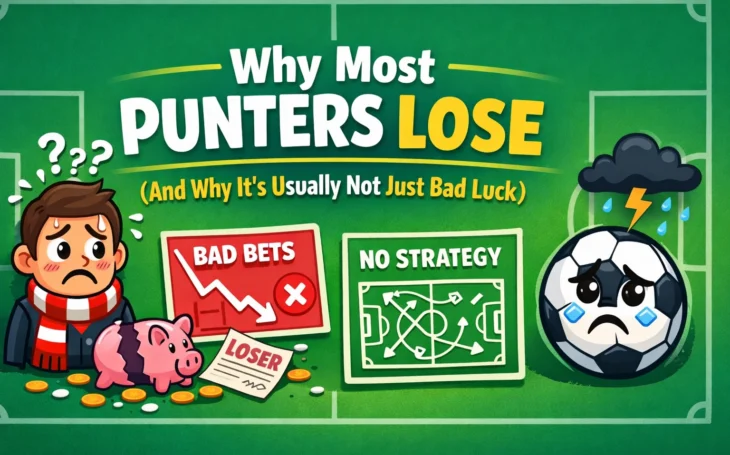
Why Most Punters Lose; we’ve all been there. It’s a rainy Tuesday night, and you’ve got a cheeky triple on the Champions League. Everything is going smoothly until the 89th minute when a random substitute scores a fluke header, ruining your slip.
“I’m just so unlucky,” you tell yourself as you close the betting app.
But here’s the cold, hard truth: while that specific goal might have been unlucky, your long-term losses probably aren’t. In fact, for about 90% of punters, luck has very little to do with why the bankroll keeps hitting zero.
If you’ve ever felt like the bookies have a personal vendetta against you, don’t worry. You’re not alone. Most people fall into the same traps. The good news? Once you spot these common betting mistakes, you can actually start doing something about them.
Let’s talk about why most bettors lose and how you can stop being one of them.
If we’re being mates here, I’ve got to be honest with you. Most punters are a bit lazy.
It’s way easier to place a bet based on a “feeling” or because “Liverpool always win at home” than it is to actually look at the data. We call this the “Hunch Tax.” It’s the price you pay for not doing your homework.
Research suggests that one of the primary reasons people lose money is a total lack of preparation. Many punters expect to turn a profit without ever opening a spreadsheet or looking at team form beyond the last two results.
In the world of football betting, “vibes” don’t pay the bills. If you’re betting on a team just because you like their striker or you saw a funny tweet about them, you’re essentially just donating your money to the bookmaker’s holiday fund.

We need to talk about football betting psychology. For a lot of people, betting is a hobby. It’s entertainment. There’s absolutely nothing wrong with that: if you’re okay with paying for that entertainment.
But if your goal is to actually see that account balance go up, you have to stop treating it like a trip to the cinema.
Casual punters often treat betting as a way to make a boring game more exciting. This leads to “boredom betting”: placing a wager on a random game in the Bulgarian second division just because it’s the only thing on at 2 PM on a Monday.
When you bet for excitement, you’ve already lost. You’re making decisions based on dopamine, not data. Professional bettors (the ones who actually make a living at this) are often quite bored. They follow a process. They wait for the right entry. They don’t chase the rush; they chase the value.
We all love a 12-fold accumulator. We’ve all spent five minutes on a Saturday morning dreaming about how we’d spend the £10,000 we’d win from a £1 stake.
But let’s be real: long-shot accas are basically lottery tickets with better marketing.
The more teams you add to your slip, the more you increase the bookie’s “margin” (their built-in profit). While it feels like you’re getting great odds, the actual mathematical probability of all those events happening is usually much lower than the odds suggest.
Most punters lose because they are obsessed with the “Big Win” rather than consistent, smaller gains. If you want to improve your process, start looking at singles or doubles. It’s not as “sexy,” but it’s how you actually build a bankroll.
This is the big one. You could be the best football analyst in the world, but if your bankroll management betting strategy is non-existent, you will go broke. Period.
Common betting mistakes almost always involve stakes that are too high.
Does this sound familiar? You have a “sure thing” (which doesn’t exist, by the way), so you put 50% of your balance on it. It loses. Now you’re annoyed, so you put the remaining 50% on a random late-night game in Brazil to “get back to even.”
That’s not betting; that’s a spiral.
A proper process involves betting a consistent percentage of your bankroll: usually between 1% and 3% per bet. This keeps you in the game even when you hit a losing streak (which will happen to everyone). If you’re interested in how to structure this better, check out our guide on 5 expert rules for betting on football.

We live in a world of instant gratification. We want the win, and we want it now.
Most punters quit or change their strategy after three losing bets. They assume the strategy “doesn’t work” and go looking for a new “system” or a “pro tipster” who promises 100% win rates (spoiler alert: they’re lying).
Successful betting is a marathon, not a sprint. It takes time to find an edge and even more time for that edge to show up in your profits. If you can’t handle a losing week without losing your head, the “luck” will always seem to be against you.
I see this all the time on social media. People looking for “fixed matches” or “inside info.”
Let’s clear this up right now: nobody is selling you a fixed match for £20 on Telegram. If someone actually had a fixed match, the last thing they would do is tell a stranger on the internet and alert the authorities/bookies.
Falling for these scams is one of the most avoidable football betting mistakes. Instead of looking for a “cheat code,” focus on improving your own analysis. You can read more about the truth about fixed matches to save yourself some time and money.
So, how do you stop being the punter the bookies love? It starts with changing your process.

There’s a thin line here. Gambling is about the thrill. Betting (or trading) is about the value.
The moment you start chasing losses or betting money you can’t afford to lose, you’ve moved into gambling territory. If you want to win more often, you have to approach this with the discipline of a business owner, not the desperation of a gambler. You can read more about the difference between gambling and betting to help shift your mindset.
At the end of the day, the bookies win because they have a better process than the average person. They don’t get emotional. They don’t chase losses. They rely on cold, hard maths.
If you want to beat them, you have to start acting a bit more like them.
Stop looking for “tips” and start looking for “value.” Stop blaming “bad luck” and start looking at your bankroll management. When you stop worrying about the result of a single game and start focusing on the quality of your decisions, you’re already ahead of 90% of the people betting today.
**The Practical Tip:** Before you place your next bet, ask yourself: *”If I made this exact same bet 100 times, would I realistically be in profit?”* If the answer is “I don’t know” or “Probably not,” keep your money in your pocket. Betting is about finding an edge that works over the long haul, not just getting lucky once.
[…] ruins everything. When you bet, your entire stake is at risk until the final whistle blows. This is why most punters lose, they can’t handle the swings and start chasing […]
[…] Most punters don’t lose because they’re “unlucky”. They lose because their process is a mess. If that hits a bit too close to home, this will help: why most punters lose (and why it’s usually not just bad luck). […]