



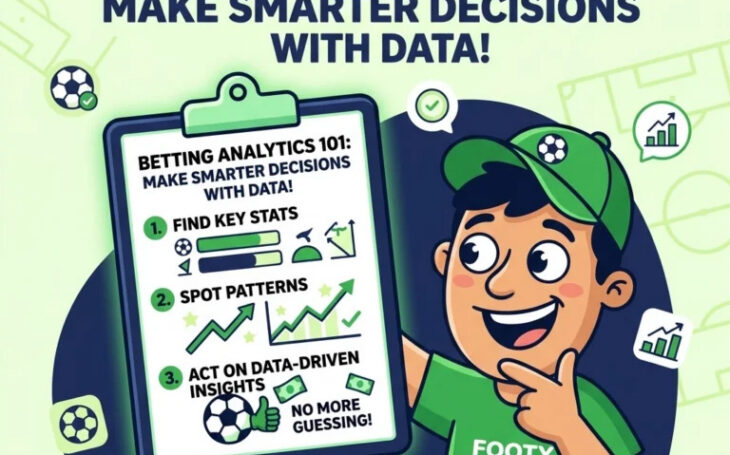
Betting Analytics; we’ve all been there. It’s Saturday morning, you’ve got your coffee in one hand and your phone in the other, scrolling through the 3:00 PM kick-offs. You see a team like Chelsea playing at home against a mid-table side, and your brain immediately screams, “They’re due a win, surely!”
You place the bet, sit back, and watch as they limp to a 0-0 draw or, worse, concede a scrappy goal in the 88th minute.
The problem? You bet with your gut, not with data.
In the world of football betting, your “gut” is usually just a fancy word for bias. If you want to move away from being a “casual punter” who loses their shirt every weekend and start acting like a pro, you need to understand betting analytics.
Don’t panic: you don’t need a degree in advanced maths or a supercomputer in your spare room. You just need a simple framework to make smarter, data-driven decisions. Let’s dive in.
Most people bet based on what they think should happen. They remember a team playing well three weeks ago, or they see a famous badge and assume quality. This is what we call cognitive bias.
The bookies love this. They set their prices based on public perception because they know the average fan will overvalue big names and “narratives.”
Data-driven betting is the antidote to this. It’s about looking at the cold, hard numbers to see what is actually happening on the pitch, rather than what the commentators are talking about. When you start using analytics, you stop betting on who you want to win and start betting on where the value lies.

At its simplest, betting analytics is the process of using historical and real-time data to find a mathematical edge over the bookmaker.
Instead of saying “I think there will be goals in this game,” an analyst says: “In the last 10 games where these two teams met with these specific line-ups, over 2.5 goals happened 70% of the time. The bookie is offering odds that suggest it only happens 50% of the time. That is a value bet.”
You don’t need to track a thousand variables. Start with these three:
An edge is simply a situation where your calculated probability of an event happening is higher than the probability implied by the bookmaker’s odds.
Think of it like a coin flip. A fair coin has a 50% chance of landing on heads. In betting terms, that’s odds of 2.00 (Evens). If a mate offers you odds of 2.50 on heads, you’d take that bet every single day because you have an edge.
In football, we use analytics to find those “mispriced” coin flips. If you’re struggling to make your current approach work, you might want to check out our guide on 10 reasons your football betting strategy isn’t working. Usually, it’s because the edge just isn’t there.

If you’re new to this, don’t try to predict every league in the world. You’ll burn out and lose your bankroll. Follow this simple process instead:
Don’t be a jack-of-all-trades. Pick a specific market like Over 1.5 Goals or First Half Goals. By narrowing your focus, you’ll start to notice patterns that others miss. For example, you might find that the Icelandic second division is incredibly consistent for over 1.5 goals tips.
You could spend six hours a day looking at spreadsheets, or you could use technology. A good soccer scanner can monitor thousands of games simultaneously and send an alert to your phone when your specific “data criteria” are met.
Imagine getting a text saying: “Newcastle vs Brighton has had 5 corners and 8 shots in the last 15 minutes, but it’s still 0-0.” That’s data-driven power in your pocket.
You must track your bets. If you don’t know why you won or lost, you aren’t an analyst: you’re just a lucky (or unlucky) punter. Record the odds, the stake, the data points you used, and the result. After 50 bets, look for trends. Maybe you’re great at picking over 2.5 goals tips but rubbish at Match Results. Use that data to refine your strategy.
Even with data, it’s easy to trip up. Here are the “punter pitfalls” to avoid:

The bookies use world-class algorithms to set their lines. If you’re just using your eyes, you’re bringing a knife to a gunfight.
Using a platform like Footy Amigo allows you to create “Smart Alerts.” You can set rules based on historical data: for instance, only alerting you to games where the home team has scored in 90% of their last 10 matches. This removes the emotion from the decision. You aren’t betting because you like the team; you’re betting because the conditions are right.
If you’re interested in specific tactical plays, have a look at these late goal strategies. They are a perfect entry point for anyone wanting to try data-driven in-play betting.
You can have the best analytics in the world, but if you bet 50% of your money on one game, you will eventually go bust.
Pro bettors use flat staking. This means betting the same small percentage of your total bankroll (usually 1% to 3%) on every single bet. This keeps you in the game during a losing streak. Remember, analytics is about the long game. One game is noise; 1,000 games is a business.
Moving from “gut feelings” to “data-driven decisions” is the single biggest step you can take to becoming a profitable bettor. It stops the emotional rollercoaster and turns betting into a logical, disciplined process.
You don’t need to be a math genius. You just need to be curious, disciplined, and willing to let the numbers lead the way.
Practical Tip to Remember:
Next time you feel “certain” about a result, stop and ask yourself: “What three pieces of data support this feeling?” If you can’t name them, don’t place the bet. Use a tool to find the stats first, then decide.