



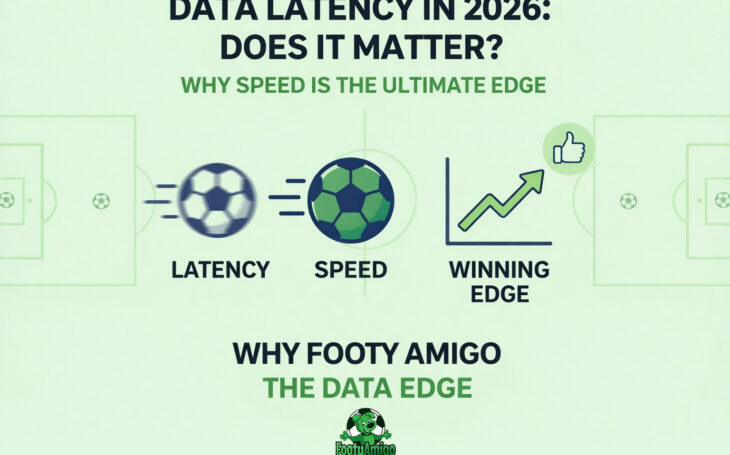
Data Latency; we’ve all been there. You’re sitting on the sofa, watching the big match on a “high-definition” live stream. Your phone buzzes in your pocket. It’s a notification from a scores app: Goal!
You look at your TV screen. The ball is still stuck in a scrappy midfield battle. Thirty seconds later, the striker breaks free, rounds the keeper, and slots it home. The commentator screams, but the magic is gone. You already knew.
In 2026, you’d think we would have solved this. We have 5G, 6G and satellites orbiting the earth like clockwork, yet the gap between “live” reality and what you see on your screen is wider than ever. If you’re just a casual fan, it’s an annoyance. But if you’re serious about football in play trading strategies, that 30-second delay is a bankroll killer.
The truth is, most “live” coverage isn’t live at all. Whether you’re watching on a digital terrestrial signal, a cable box, or (heaven forbid) a web-based stream, you are looking into the past.
When a goal is scored, the signal has to be encoded, sent to a satellite, processed by a broadcaster, beamed back down to your provider, and finally decoded by your hardware. Each step adds a few seconds. By the time the pixels hit your eyeballs, the bookmakers have already moved the odds, the smart money has been placed, and the value has vanished.

In the world of betting analytics, we call this “latency.” And in 2026, latency is the hidden tax that most bettors pay without even realising it.
If you’re trying to find an edge using a slow stream, you aren’t just competing against the bookie: you’re competing against time itself. And time always wins.
Have you ever wondered why the “Cash Out” button suddenly disappears or why the markets get “Suspended” just as a team starts a dangerous-looking attack?
It’s because the bookmakers aren’t watching the same stream you are. They pay tens of thousands of pounds for direct, raw data feeds from the stadium. These feeds are transmitted at the speed of light, often reaching their trading desks within milliseconds of the action happening.
While you’re watching a slow-motion replay of a foul, the bookie’s algorithm has already seen the quick free-kick, calculated the new probability of a goal, and shut the market down. They are essentially playing poker while seeing your cards 30 seconds before you do.
To beat them, you need to stop relying on your eyes and start relying on faster data. This is where an in play scanner becomes your best friend.
Let’s look at a common scenario. Team A is dominating. They’ve had three corners in five minutes. You’re watching the stream and you see them win another one. You think, “They’re going to score here,” and you rush to place a bet on ‘Next Goal’.
But wait. The odds have already dropped from 3.0 to 2.2. Or worse, the market is suspended.
Why? Because in the real world, that corner was taken 20 seconds ago. The ball was cleared, a counter-attack started, and the bookie is currently recalculating the odds for Team B. You are betting on stale information.
By the time you see the “value,” it’s already gone. If you want to get ahead, you need to use tools that alert you to these shifts the moment they happen in the real world, not when they finally appear on your telly.
In 2026, raw data is the ultimate edge. While most people are looking at the scoreline, smart traders are looking at “Dangerous Attacks” (DA).
A “Dangerous Attack” is generally defined as an offensive move where a team enters the final third of the pitch with the ball. It’s a much more reliable indicator of an impending goal than simple possession stats.

At Footy Amigo, our live data feeds track these stats in real-time. When a team’s DA count spikes: say, they’ve had 10 dangerous attacks in the last 10 minutes: it’s a massive signal that a goal is brewing. Our InPlay alerts reach your phone or telegram faster than any TV broadcast.
Instead of waiting for the commentator to get excited, you get a ping. You see the data: Home Team is hammering the door down. You can check the Betfair markets and get your position in while the rest of the world is still watching the goalkeeper take a goal kick on their delayed stream.
If you’re involved in football in-play trading strategies on Betfair, speed isn’t just a “nice to have”; it’s the difference between profit and loss.
Betfair is a peer-to-peer exchange. You aren’t just betting against a faceless bookie; you’re betting against other people. Some of those people are sitting in the stadium with a smartphone. Others are using high-frequency bots that react to data changes in milliseconds.
If you’re sitting there with a 30-second delay, you are the “liquidity” (a polite way of saying “the person losing money”) for the faster traders.
By using Footy Amigo’s in play scanner, you level the playing field. Our alerts are designed to bridge that gap. You can set up specific triggers: for example, “Alert me if a match is 0-0 at 70 minutes, but the away team has had more than 5 shots on target and a DA ratio of 2:1.”
When that alert hits your phone, you know you have a high-probability trade. You don’t need to watch 50 games at once; you just need to react to the right data at the right time. This is how you integrate in play alerts with your Betfair strategy effectively.
The research is clear: in 2026, AI agents are now communicating with each other at machine speed. Systems are being built where “milliseconds compound across interconnected systems.”
In the betting world, this means the window of opportunity is shrinking. If an AI bot detects a value gap based on live match stats, it will fill that gap almost instantly. As a human, you can’t be faster than a bot, but you can be faster than other humans.
Using ultra-low latency data allows you to spot trends before they become obvious to the masses. It’s about being in the “front of the queue.” If you can’t be the fastest bot in the world, you should at least aim to be the fastest human in the market.
So, how do you actually use this “speed edge” without becoming a maths professor? It’s simpler than you think.
If you’re just starting out, we have a great guide on the 5 steps to build a football betting system that explains how to turn these ideas into a repeatable process.

Speed is a tool, but it’s not a magic wand. Having the fastest data in the world won’t help you if your strategy is rubbish. But even the best strategy in the world will fail if you’re always 30 seconds late to the party.
The most common mistake bettors make is thinking they can “out-read” a game by watching it. We are biased creatures. We see a team play a nice pass and we think they are dominant. The data might show they’ve only had one shot all game.
Footy Amigo removes the emotion and the lag. It tells you what is happening now, not what happened a minute ago. Whether you are looking for predictions for today’s football or building a complex in-play model, the foundation must be fast, accurate data.
The 60-Second Rule: Next time you’re watching a live game on a stream and want to place an in-play bet, check the “Dangerous Attacks” and “Shots on Target” stats on a live data tool first.
If the stats show a goal has likely just happened or the pressure has shifted, but your stream is still showing a boring goal kick: walk away. Never place a bet based on a visual stream that is behind the live data. You’ll save yourself a fortune in “suspended market” frustrations alone!
Ready to get the edge? Check out our pricing plans and start using the data the bookies don’t want you to have. ⚽️📈
[…] talked before about why speed is the ultimate edge, and it has never been more relevant than for the 2026 World Cup. When a red card happens in a […]
[…] need to know how the “big boys” play. We’ve actually written a whole deep dive on does data latency really matter in 2026. To fix this, stop trying to beat the bookie on “fast” events like the next corner or […]