



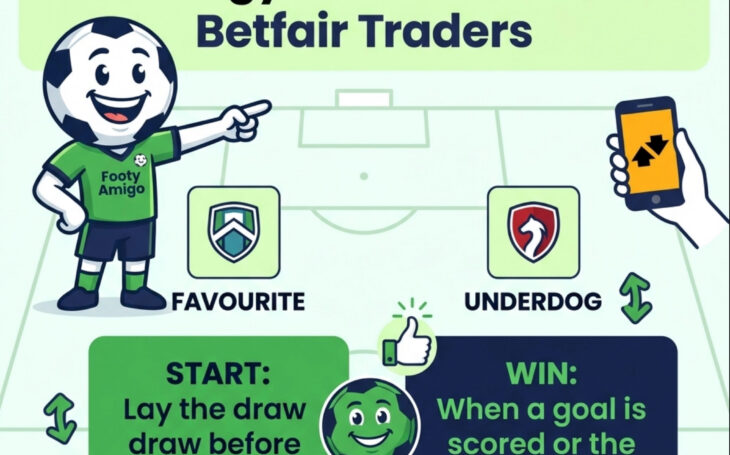
If you’ve spent more than five minutes looking into betfair football trading, you’ve definitely heard of “Lay the Draw” (LTD). It’s basically the “Bread and Butter” for most traders. It’s the strategy everyone starts with, and for good reason, it’s logical, relatively simple to understand, and when done right, it feels like you’ve cracked the code.
But here’s the reality check: most people get it wrong. They jump into any old match, pray for a goal, and then panic when the clock hits 70 minutes and it’s still 0-0.
In this guide, we’re going to strip away the fluff. I’ll explain how the lay the draw strategy football actually works, why selection is everything, and how you can use Footy Amigo to stop guessing and start trading with data.
In simple terms, laying the draw means you are betting against the match ending in a draw. You are acting as the bookmaker. If the game ends 1-0, 0-1, 3-2, or 0-5, you win your trade. The only way you lose (initially) is if the game ends in a stalemate.
The magic happens because of how the betting markets react to goals. When a goal is scored, the probability of the game ending in a draw drops significantly. In response, the “Draw” price on an exchange like Betfair shoots up. As a trader, this gives you the chance to “trade out” or “green up,” locking in a profit regardless of what happens in the remaining minutes.
It’s a classic entry point for football trading for beginners, but even the pros use it daily because of its flexibility.

Let’s look at a typical scenario. You’ve found a match where you expect goals.
It sounds easy, doesn’t it? But what if the underdog scores? Or what if it stays 0-0 until the 80th minute? That’s where the “Mastering” part comes in. If you want to dive deeper into the basics before going pro, check out our football trading 101 guide.
You can’t really do this at a traditional high-street bookie. They want you to bet and lose. For this strategy, you need an exchange. Betfair football trading is popular because of the “liquidity”: there is enough money moving through the markets to let you enter and exit trades instantly.
In the fast-paced world of in-play trading, speed and data latency are your best friends. If you’re trying to trade out after a goal but your data is 30 seconds behind the market, you’re going to get “stung” by price movements you didn’t see coming.
The biggest mistake traders make is “LTD-ing” every game on a Saturday afternoon. That’s a one-way ticket to a depleted bankroll. To master the lay the draw strategy football, you need a checklist.
You aren’t just looking for a game that won’t be a draw; you are looking for a game where the probability of a goal is high, and the timing of that goal is likely to happen when the market is most volatile.
Here is what the pros look for:

This is where the “Sports Technology” part of our name comes in. Instead of spending six hours on a Saturday morning staring at spreadsheets, you can let Footy Amigo do the heavy lifting.
We allow you to set up “In-Play Alerts.” Imagine this: You only want to Lay the Draw if a game is 0-0 at the 30-minute mark, but the home team has had at least 3 shots on target and a dangerous attack every 5 minutes.
Instead of watching 20 games at once (which is impossible unless you’re an octopus), Footy Amigo sends a “ping” to your phone the second a match hits those exact criteria.
Laying the draw “cold” (before kick-off) is fine, but laying the draw “in-play” is where the real edge is. If a match is 0-0 at halftime, the draw price will be much lower (say, 2.5 instead of 4.0). This means your “liability” (the amount you risk) is much smaller, but the potential profit if a goal is scored is much higher.
Using Footy Amigo to find these “Pressure Cooker” games: where a goal is practically screaming to happen: is how you move from a gambler to a professional trader.
Trading isn’t just about the entry; it’s about the exit. You need a plan for three scenarios:
Losing a trade is part of the game. The goal is to make sure your winning trades are larger than your losing ones. It’s all about improving your betting discipline.

Even with the best tools, humans are great at making mistakes. Here are a few “classics” we see all the time:

Mastering the lay the draw strategy football is a marathon, not a sprint. It’s about finding a repeatable process, using data to filter out the noise, and staying disciplined when things don’t go your way.
Remember, the market doesn’t care about your “hunch” that a goal is coming. It only cares about the maths. By using Footy Amigo to alert you to high-pressure games where the stats suggest a breakthrough is imminent, you are giving yourself the ultimate edge over the thousands of casual punters who are just “having a go.”
Practical Tip: Next time you’re looking at an LTD trade, don’t just look at the score. Look at the “Dangerous Attacks” in the last 10 minutes. If a team is putting on the pressure, the market often hasn’t fully priced in that “imminent” goal yet. That’s your window of opportunity.
Happy trading, and remember: let the data do the talking!