



Expected Goals (xG); we’ve all been there. You’re watching a match, and one team is absolutely battering the other. They’ve had fifteen shots, ten corners, and the commentator is screaming about “one-way traffic.” Naturally, you pop a few quid on them to score next.
Ten minutes later, the other team, who haven’t crossed the halfway line once, lump a long ball forward, their striker scuffs a shot, it hits a defender’s shin, and it trickles into the net.
Bet lost. Remote thrown. Pizza cold.
The problem isn’t your “bad luck.” The problem is that you were looking at quantity, not quality. In the world of smart betting, we call the solution to this problem Expected Goals (xG).
If you want to stop betting with your gut and start betting with your brain, understanding xG is the single biggest “level up” you can take. Let’s break it down over a virtual pint.
At its simplest, Expected Goals (xG) is a way of measuring how good a scoring chance actually was.
In the old days of betting (about five years ago), we just looked at “Shots on Target.” But as any football fan knows, not all shots are created equal. A tap-in from two yards out is a much better chance than a desperate 40-yard “ave-a-go” screamer that the keeper catches easily.
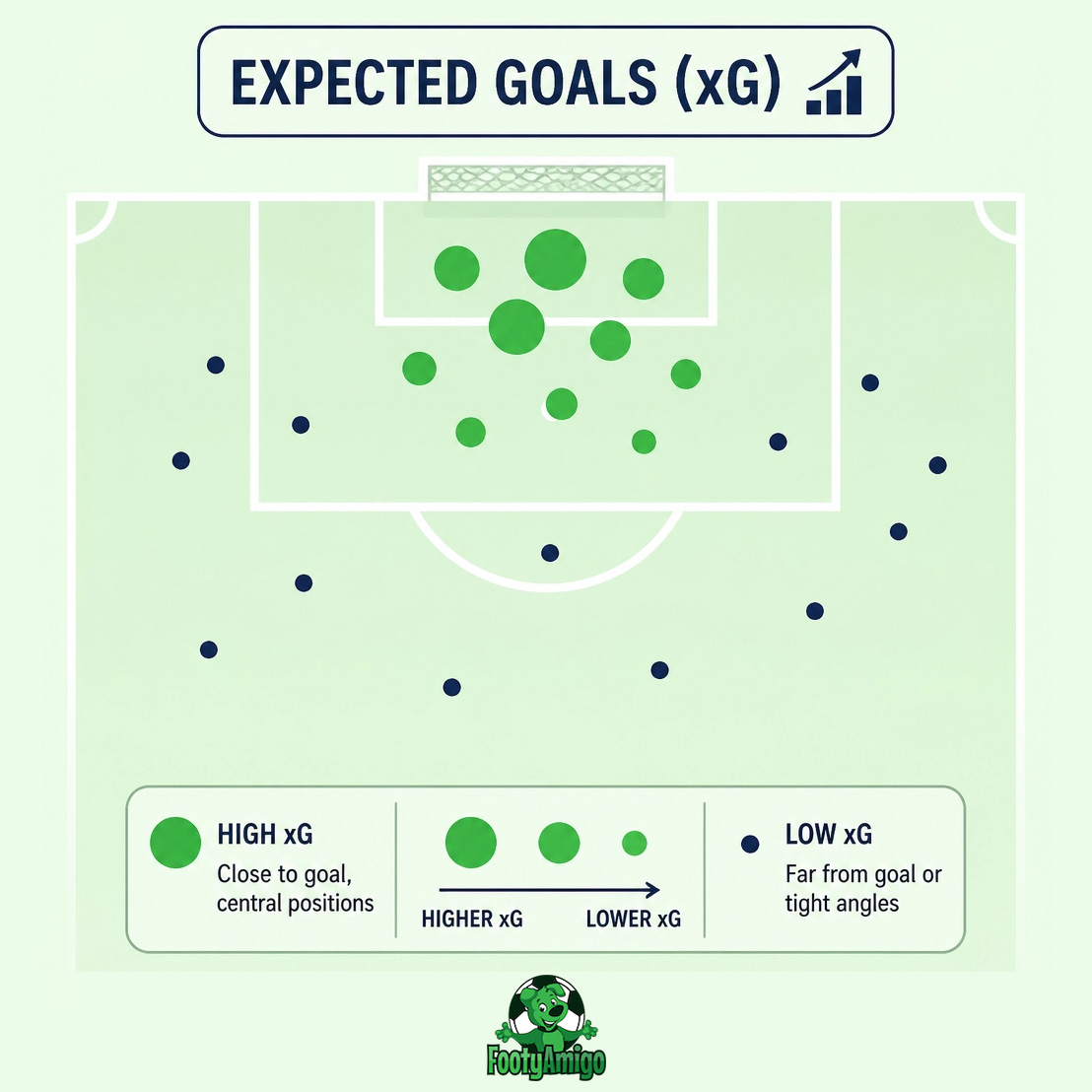
xG gives every single shot a value between 0 and 1.
When you add all these numbers up during a match, you get a much clearer picture of who is actually “winning” the battle of quality. If a team has 20 shots but an xG of only 0.50, they aren’t “dominant”, they’re just wasteful.
When a match is live, the scoreline often lies to you. This is where most punters lose their bankroll. They see a 1-0 scoreline and assume the winning team is the better team.
Smart punters use Expected Goals (xG) as a “Pressure Gauge.”
Imagine it’s the 70th minute. Team A is losing 1-0. However, their live xG is 1.85, while the team winning has an xG of only 0.20.
This tells you that Team A is creating massive, high-quality chances but hasn’t had the rub of the green yet. The odds for Team A to score next or for “Over 1.5 Goals” will often be much higher than they should be because the bookies are reacting to the clock, not the quality of the play. This is a prime value betting opportunity.
On the flip side, if a team is leading 2-0 but their total xG is 0.15, they’ve basically scored two “flukes.” They aren’t controlling the game; they just got lucky. If the other team starts piling on the pressure, you might find great value in betting on the trailing team to score next, as the leaders are likely to crumble under actual sustained pressure.

Let’s be honest: nobody wants to sit there with a calculator during a Tuesday night Championship game trying to work out the decimal point of a header from a corner.
That’s where Footy Amigo comes in. While we provide the raw data, our platform is built to help you spot momentum shifts in real-time.
Instead of just looking at a static xG number, Footy Amigo tracks the ingredients that make up xG:
You can set up Smart Match Alerts that ping your phone the second a game hits a “High Pressure” state. For example, you can tell Footy Amigo: “Alert me if a game is 0-0 after 60 minutes, but one team has had more than 10 dangerous attacks in the last 10 minutes.”
That alert is essentially telling you: “Hey, the xG is rising fast, a goal is coming.”

Even the best tools can be used incorrectly. If you’re going to use xG in your in-play strategy, avoid these two classic blunders:
If a team is 3-0 up, their xG will often stall. Why? Because they’ve stopped attacking! They are happy to sit back and protect the lead. Don’t look at their low second-half xG and think they’re playing badly: they’re just playing smart. Always look at xG in the context of the current score.
xG tells you how good the chance was, but it doesn’t know who is taking it. If a high-quality chance (0.60 xG) falls to Erling Haaland, it’s much more likely to be a goal than if it falls to a League Two centre-back who hasn’t scored since 2019.
The difference between a “punter” and a “trader” is data. Punters bet because they feel like a goal is coming. Traders bet because the maths tells them the probability of a goal is higher than the odds suggest.
Using xG and momentum data allows you to remove the emotion from your betting. It stops you from “chasing” losses on teams that are having plenty of shots but creating zero quality.

If you’re tired of being surprised by “shock” results, it’s time to start looking at what’s actually happening on the pitch. You don’t need a degree in statistics; you just need the right tools to filter the noise.
You can start tracking live momentum and high-probability goal scenarios right now with Footy Amigo. Whether you want to build your own rules or use our Amigo Copier to follow strategies that are already working, we’ve got your back.
Practical Tip to Remember: Next time you see a team with 10+ shots but 0 goals, check their xG (or their “Dangerous Attacks” on Footy Amigo). If the quality is high, the goal is often just a matter of time. If the quality is low, keep your money in your pocket!
Stop guessing. Start winning. Join the 1% of smart punters at FootyAmigo.com.