

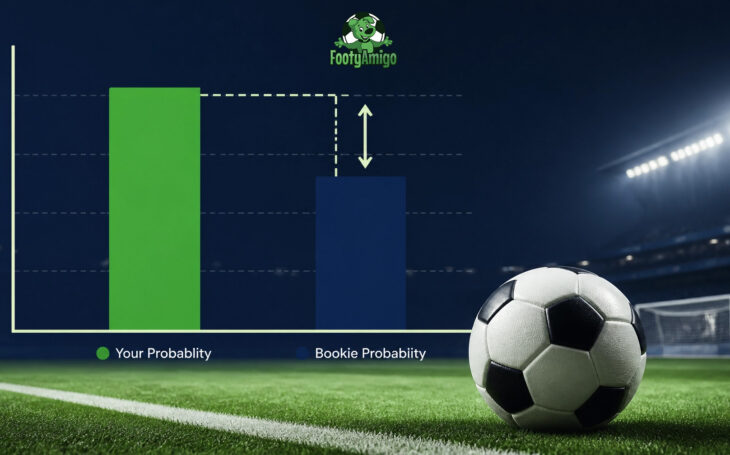
Spot Betting Value; if you’ve ever sat in the pub and heard a mate say, “I’ve got a feeling about Liverpool today, they’re a dead cert,” you’ve heard the sound of a losing bettor.
Most people bet on “who they think will win.” They look at the table, see a big team playing a smaller one, and put their money down. But if you want to move from being a casual punter to someone who actually makes a profit over the long haul, you need to stop looking for winners and start looking for value.
Spotting value is the “holy grail” of sports betting. It’s the difference between guessing and trading with an edge. In this guide, we’re going to break down exactly how to find it, the simple maths you need (don’t worry, it’s easy), and how to use data to beat the bookies at their own game.
Think of a coin toss. There are two outcomes: Heads or Tails. Each has a 50% chance of happening.
In a fair world, a bookie would give you odds of 2.00 (Evens) for either. If they offered you odds of 2.10 for Heads, would you take it? Of course you would. Even though you might lose the next flip, over 1,000 flips, you are mathematically guaranteed to profit because you’re being paid more than the “true” risk of the event.

That gap, the difference between the real probability of something happening and the probability implied by the bookmaker’s odds, is your value.
In soccer, the bookies are incredibly good at setting odds, but they aren’t perfect. They often adjust prices based on where the public is putting their money or because of a sudden “hype” around a team. Your job is to use data to find those moments where the bookie has got the probability wrong.
Before you can spot value, you need to know how to translate those numbers on your screen into percentages. This is called Implied Probability.
The formula is simple: 1 / Decimal Odds = Implied Probability.
Every time you see a price, you should immediately think: “The bookie thinks this team has a X% chance of winning.”
If you’ve done your research using a tool like Footy Amigo’s historical data and your data suggests the team actually wins 60% of the time, but the odds are 2.00 (implying 50%), you’ve found a massive value bet.
The bookies always include a “margin” or “vig.” This means they never give you the true odds. If you add up the implied probabilities of a Home win, Draw, and Away win for any match, you’ll notice they add up to about 105% or 107%. That extra 5-7% is their profit.
To win, you have to be accurate enough to overcome that margin and find the selections where they’ve been too generous.
Now, you might be thinking, “How on earth do I know if a team has a 60% chance?” You don’t need a crystal ball; you need relevant data.

When pro bettors look at a game, they don’t just look at the league table. They look at specific, high-intent metrics:
Instead of doing this manually for 1,800 leagues, smart punters use Smart Match Alerts to set filters. For example, you can tell the system: “Alert me when a home team has won 80% of their last 10 games but the odds for a home win are still above 1.80.”
We’ve all seen them: the “Betting Gods” on Twitter promising a 10-fold accumulator that “cannot lose.”
The problem with tipsters is that they rarely explain the value behind the pick. They might pick a winner, but if the odds they gave you were 1.20 and the real risk was more like 1.50, you’ve made a mathematically bad bet even if it wins.
Over time, betting on “likely winners” at poor prices is the fastest way to drain your bankroll. This is why we focus so heavily on the difference between gambling and betting. One is a roll of the dice; the other is a calculated business decision.

One of the best ways to “prove” value is to look backwards. If you have a strategy, say, betting on Over 2.5 Goals when both teams have scored in 4 of their last 5 games, you can backtest it.
If the data shows that this specific scenario resulted in a win 65% of the time over the last 3 seasons, and you can find games with odds of 1.70 (implying 58.8%), you have found a profitable edge. You aren’t guessing; you are applying a proven formula.
Ready to give it a go? Here is a simple workflow you can use for your next weekend of soccer:
If the pre-match odds don’t offer value, don’t forget the In-Play Drift strategy. Sometimes a game that is 1.50 pre-match becomes 1.90 after 20 minutes of 0-0 action, even though the stats show both teams are attacking like mad. That is pure value.
Next time you see a price that looks “too good to be true,” it probably is: unless the data says otherwise. Never place a bet because the odds “look high.” Always ask: “Does this price represent a higher probability than the stats suggest?” If you can’t justify the bet with a percentage, you’re just gambling.

Stick to the data, stay disciplined, and remember: the goal isn’t to win every bet, it’s to find every edge.