




If you’ve ever placed a bet on a “dead cert” only to watch a bottom-of-the-league side score a 94th-minute screamer, you’ve met our old friend: Betting Variance.
Most punters see variance as the enemy. They see it as “bad luck” or “the bookie being out to get them.” But here’s a secret that the top 1% of professional bettors won’t tell you over a pint: Betting ariance is actually your best friend.
Once you understand the maths (not the magic) behind why results swing the way they do, you stop being a gambler and start being a trader. You stop chasing losses and start trusting your data.
In this guide, we’re going to pull back the curtain on betting variance, explain why most people lose their shirts, and show you how to use Footy Amigo’s intelligence tools to stay on the right side of the numbers.
In simple terms, variance is the gap between what you expect to happen and what actually happens in the short term.
Imagine you’re flipping a coin. You know it’s a 50/50 shot. If you flip it 10 times, you expect 5 heads and 5 tails. But would you be shocked if you got 7 heads and 3 tails? Probably not. That’s variance.
Now, apply that to football. If you find a strategy that has a 60% win rate (which is world-class, by the way), you will still have stretches where you lose 5 or 6 games in a row.

The difference between a pro and a casual is how they react to that losing streak.
Most bettors lose because they have a “Short-Term Memory” problem. They judge their success based on a single weekend or even a single bet.
If you win three bets in a row, you feel like a genius. If you lose three, you think the system is broken. This is a psychological trap called Cognitive Dissonance. We want to believe our wins are due to skill and our losses are due to “bad luck.”
In reality, luck and skill are indistinguishable in the short term. It takes a large sample size: usually hundreds of bets: for the “maths” to beat the “magic.”
This is a fancy way of saying: the more you bet using a profitable strategy, the closer your actual results will get to your expected win rate. If your strategy is solid, time is your greatest ally. If your strategy is based on “gut feeling,” time is your worst enemy.
Variance isn’t just a mathematical concept; it’s a physical weight on your bankroll. Even with a winning strategy, you will experience “drawdowns”: periods where your balance goes down before it goes back up.
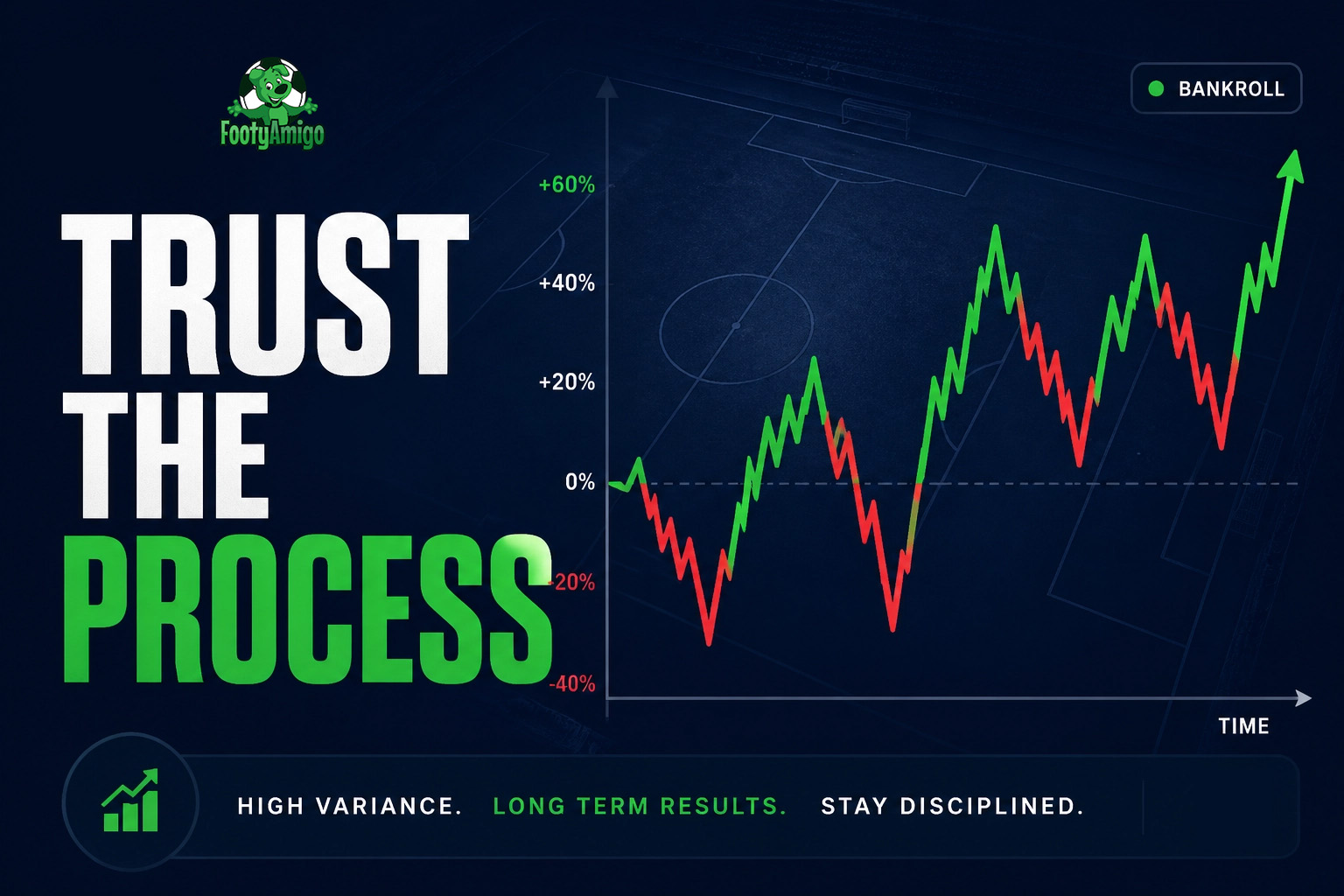
Many bettors fail because they don’t have the bankroll management to survive the “down” parts of the curve. They bet too much on one game, variance kicks in, and they’re bust before the winning streak can even begin.
At Footy Amigo, we always advocate for long-term thinking. You shouldn’t be looking at your profit daily. Look at it monthly, or better yet, quarterly.
So, how do you actually “use” variance? You do it by eliminating the noise.
The biggest source of negative variance is human emotion. When you bet based on a “feeling,” you’re adding a layer of unpredictability that no maths can account for. By using data-driven match alerts, you remove that layer.
This is where the magic (the real kind) happens. Instead of scrolling through 1,800 leagues trying to find a “vibe,” you set strict conditions.

When you receive an alert, you know the data supports it. If that bet loses? That’s just variance. You don’t care, because you know the next 100 bets using that same logic are statistically likely to put you in the green.
To join the elite group of punters who actually make a profit, you need to shift your mindset.
Next time you lose a bet that “should have won,” don’t check the scores for the rest of the night. Instead, check your strategy’s historical win rate. If the data is still green, you’re still winning: even if your balance is temporarily red.
Ready to stop guessing and start winning? Join thousands of smart punters at FootyAmigo.com and turn the maths in your favour today.
[…] Smaller leagues can sometimes have wild results due to lower player quality. This is why bankroll management is vital. Never go “all in” just because the stats look […]
[…] with your stakes, you ensure that a bad weekend doesn’t wipe you out. Understanding the maths behind betting variance is a vital part of keeping your cool when the results don’t go your […]