



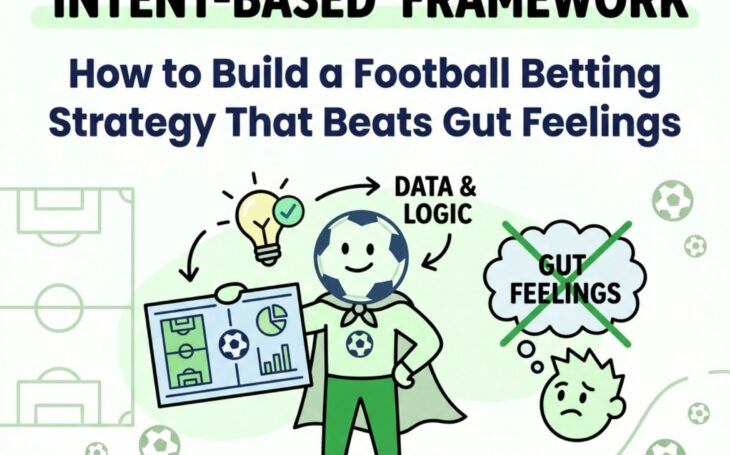
Football Betting Strategy; we’ve all been there. It’s 2:55 PM on a Saturday. You’re looking at the team sheets for a random Championship match, and you get “that” feeling.
You know the one. Your brain tells you, “Stoke haven’t won in four games, they’re at home, and they’re playing a side with a leaky defence. They are definitely due a win today.”
You place the bet. Within twenty minutes, Stoke are 2-0 down, they’ve had one shot off-target, and you’re left wondering why you listened to your gut again.
The truth is, gut feelings are the bookmakers’ best friend. If we want to learn how to bet smarter on football, we have to move away from “hunches” and towards a system.
At Footy Amigo, we call this the Intent-Based Framework. It’s a way to filter out the noise and build a strategy that relies on what is actually happening on the pitch, rather than what you think might happen.
Most people lose money because they bet on narratives, not data. Narratives are stories we tell ourselves to justify a gamble.
While these things matter, they aren’t a strategy. They are variables. A real strategy requires a repeatable process. When you’re figuring out how to build a football betting strategy, the first thing you need to kill is the “hunch.”
Bookies spend millions on complex maths and AI to set their prices. If your only weapon against that is a “feeling” you got while eating a bacon sarnie, you’re bringing a toothpick to a gunfight.

Intent-based betting is the practice of looking for statistical evidence of a team’s objective.
Instead of just looking at the final score of the last five games, we look at what the team was trying to do. For example, a team might have lost 1-0, but they had 15 corners, 20 shots, and 3.5 Expected Goals (xG). Their intent was to attack and score. The result was just a bit of bad luck.
On the flip side, a team might have won 1-0 with their only shot of the game. Their intent was to sit back and defend. If you bet on them to score “Over 1.5 Goals” in their next match because they won the last one, you’re ignoring the data.
The scoreline is a liar. It’s the most basic piece of data, and often the most misleading.
To build a proper strategy, you need to look at football betting methods that weigh “Intent Metrics” like:
When you start focusing on intent, you stop being surprised by “upsets” and start seeing them coming.
You can’t build a house on sand, and you can’t build a betting strategy on a whim. Your foundation must be historical data.
When you are looking at how to build a football betting strategy, you need to pick a specific market. Don’t try to master everything. Pick one: Over 2.5 Goals, BTTS (Both Teams to Score), or perhaps First Half Goals.
Let’s say you choose Over 1.5 Goals tips. Your data foundation would involve looking for teams where:
This isn’t a hunch. This is a statistical probability.

Once you have the data, you apply the Intent Filter. This is where you look at the “Why.”
Is there a reason the data might be skewed? If a team usually scores loads but their three best attackers are out with flu, their intent to score remains, but their ability is gone.
Conversely, look for “Intent Triggers.” A team fighting for a Champions League spot playing against a team with nothing to play for in the last three games of the season is a classic intent trigger. One team is desperate; the other is mentally on a beach in Ibiza.
The biggest enemy of a smart punter is their own brain. Even with a great strategy, we get greedy, we get scared, or we try to “chase” a loss.
This is where 5 habits of the top 1% of smart punters come into play. One of those habits is using technology to strip away the emotion.
Instead of sitting at your laptop refreshing scores and feeling your heart rate rise, you can use tools like Footy Amigo to set “Smart Alerts.” You tell the system your criteria, the data and the intent, and it only pings your phone when a match matches your exact strategy.
If the game doesn’t hit your stats, you don’t bet. No “maybe,” no “it looks like a good game,” no emotion. Just cold, hard execution.

The “Due a Win” fallacy is perhaps the quickest way to empty a bankroll. In the world of maths, the past doesn’t dictate the future in the way we think it does.
If a coin flips heads five times in a row, the chance of it being tails next time is still exactly 50%. Football is more complex, but the principle holds. A team isn’t “due” anything. They win when their intent, tactics, and execution outmatch the opponent.
Instead of betting on someone to turn their luck around, look for predictions today football that are backed by consistent, high-intent performance data.
The ultimate version of the Intent-Based Framework happens live. Pre-match stats are great, but the first 15 minutes of a game tell the real story.
Sometimes a “High Over 2.5 Goals” game starts, and both teams look like they’ve forgotten how to run. If you bet pre-match, you’re stuck. If you use an in-play scanner, you can wait for the intent to show up.
Is a team down by a goal but peppering the target? That’s intent. Is a favourite playing against 10 men but failing to create a single chance? That’s a lack of intent. Avoiding these in-play betting mistakes is what separates the pros from the Saturday afternoon hobbyists.
If this sounds like a lot of work, that’s because it used to be. You’d need twelve browser tabs open and a spreadsheet that looked like a NASA launch code.
We built Footy Amigo to do the heavy lifting for you. You can create your own “Amigos” (automated bots) that scan thousands of games across the globe. You set the rules based on the Intent-Based Framework, and the Amigo sends you a Telegram alert the second a match fits.
Whether you are looking for sure home win predictions or niche markets like first half over 0.5 goals, the framework remains the same:

Building a football betting strategy isn’t about finding a “magic” tipster who gets it right every time. It’s about building a repeatable process that gives you an edge over the long term.
Stop listening to the pundits on TV who get paid for “hot takes.” Stop listening to that feeling in your gut that tells you a team is “due.”
Start looking for intent. Start looking at the data. And most importantly, start treating your betting like a business rather than a trip to the casino. If you want to see how the pros do it, check out how it works and see how automation can change your game.
Penny’s Practical Tip:
Next time you’re about to place a bet based on a “hunch,” stop and ask yourself: “If I had to explain this bet using only three statistics (like Shots on Target or Dangerous Attacks), could I do it?” If the answer is no, keep your money in your pocket. Intent is everything!