Football Trading; let’s be honest, we’ve all been there. You’ve placed a pre-match bet on the favourite, they concede a fluke goal in the first ten minutes, and suddenly you’re watching your money disappear while the underdog parks the biggest bus in Europe.
It’s frustrating, isn’t it? But what if I told you that the pros don’t just “bet” and hope for the best? They trade.
If you want to move away from the “hit and hope” approach and bring some structure to your betting, you’re in the right place. This is the ultimate guide to football trading for beginners and those looking to level up their game using the data tools we’ve built here at Footy Amigo.
Before we dive into the deep end, let’s get the basics sorted.
In a traditional bet, you’re stuck. You back a team, and you wait until the whistle blows to see if you won or lost. Trading is different. When you trade, you’re looking to profit from the movement of odds during the match.
Think of it like the stock market, but instead of buying shares in Apple, you’re buying “shares” in a goal happening in the next ten minutes. You can enter and exit positions while the market is open (exchanges suspend it briefly around big moments such as goals and penalties).
Trading happens on betting exchanges such as Betfair or Smarkets, where you bet against other people rather than a bookmaker. You can back an outcome (bet that it will happen, like a normal bet) or lay it (bet that it won’t, taking the bookmaker’s side). Back and lay the same outcome at different prices and you can close your position before the final whistle, either locking in a smaller profit or cutting a loss. Exchanges charge commission on your net winnings in each market, so build that into every sum.
The beauty of in-play trading is that you have more information than you did before kick-off. You can see if the star striker looks like he’s had a heavy night out, or if one team is absolutely peppering the goal with “Dangerous Attacks.”

Success in this game isn’t about “gut feeling.” Your gut is usually just hungry or wrong. Consistency comes from having repeatable football trading systems.
A system is simply a set of rules that tells you when to enter a trade and, more importantly, when to get out. Without rules, you’re just a punter with a fancy app.
At Footy Amigo, we’re obsessed with the 5 steps on how to build a football betting system. For trading, those steps are even more vital. You need to know:
Many traders watch “Dangerous Attacks” (DA).
If a team has 50 attacks but 0 dangerous ones, they’re basically just passing the ball around the back. However, if a team has a high ratio of dangerous attacks: say, 66% of their total attacks are dangerous: it means they are getting into the “red zone” constantly.
A high DA count together with several shots on target tells you a side is creating chances. It doesn’t make a goal certain, and the market can see the same numbers, so always ask what the price already assumes before you act.
You don’t need a hundred different football trading strategies. You just need two or three that you understand inside out. Here are three common ones, and what our 2026/27 data says about them.
This is the “old reliable” of football trading. When you “lay” the draw, you are betting against the draw. If anyone scores, the odds of the draw will usually shoot up, and you can back the draw at the higher price to close the trade in profit.
Worked example (before commission): you lay the draw at 4.0 with a £25 stake, so your liability is £75. A goal goes in and the draw drifts to 8.0. Backing the draw for £12.50 now leaves you £12.50 up whatever the final score: £25 − £12.50 if the match isn’t drawn, or £87.50 − £75 if it is. If no goal comes, the draw price shortens as the clock runs down, and closing the trade costs you money instead.
But here’s a common trap: laying the draw at kick-off in any match.
The smart move? Wait.
Wait until 15-20 minutes into the match. Use the Footy Amigo In-Play Scanner to see if the game is actually lively. If it’s 0-0 but both sides are getting shots on target and corners, that is a better-informed entry point. The draw price will have shortened a little by then, so your liability for the same stake will be lower.
Know the base rates. Across the eight leagues in our weekend previews, 173 of the 688 league matches played this season up to 26 October 2026 (25.1%) ended level, but only 39 (5.7%) finished 0-0. Of the 186 matches still goalless at half-time, 147 (79.0%) had a second-half goal and 39 (21.0%) didn’t. League by league (FootyAmigo data, every score cross-checked against football-data.co.uk):
| League | Matches | Ended level | Ended 0-0 | 0-0 at half-time | Of those, no 2nd-half goal |
|---|---|---|---|---|---|
| Premier League | 80 | 23 (28.8%) | 6 | 31 | 6 |
| Championship | 144 | 40 (27.8%) | 9 | 33 | 9 |
| La Liga | 99 | 27 (27.3%) | 9 | 33 | 9 |
| Serie A | 80 | 14 (17.5%) | 1 | 26 | 1 |
| Bundesliga | 63 | 13 (20.6%) | 5 | 15 | 5 |
| Ligue 1 | 72 | 19 (26.4%) | 6 | 22 | 6 |
| Eredivisie | 90 | 26 (28.9%) | 1 | 17 | 1 |
| Scottish Premiership | 60 | 11 (18.3%) | 2 | 9 | 2 |
| All eight | 688 | 173 (25.1%) | 39 | 186 | 39 |
Draws have been rarest in Serie A (14 of 80) and the Scottish Premiership (11 of 60). The Eredivisie has had the highest share (26 of 90, just above the Premier League’s 23 of 80) but just one goalless game. The gaps are wide outside these eight too: 34 of 90 Ligue 2 matches (37.8%) were 0-0 at half-time, against 17 of 90 in the Eredivisie (18.9%), and 8 Ligue 2 matches ended 0-0, against one in the Eredivisie.
Plan your exit before you enter. If the favourite scores, you can close the trade there and then: a 1-0 lead isn’t safe, and in those eight leagues the team that scored first failed to win about one match in three this season (see the first-goal table in our weekend stats preview). If the underdog scores, the draw price may move less, because the market expects the favourite to come back. And if it’s still 0-0 at the minute you set in advance, close the trade for a smaller loss rather than wait for a goal.
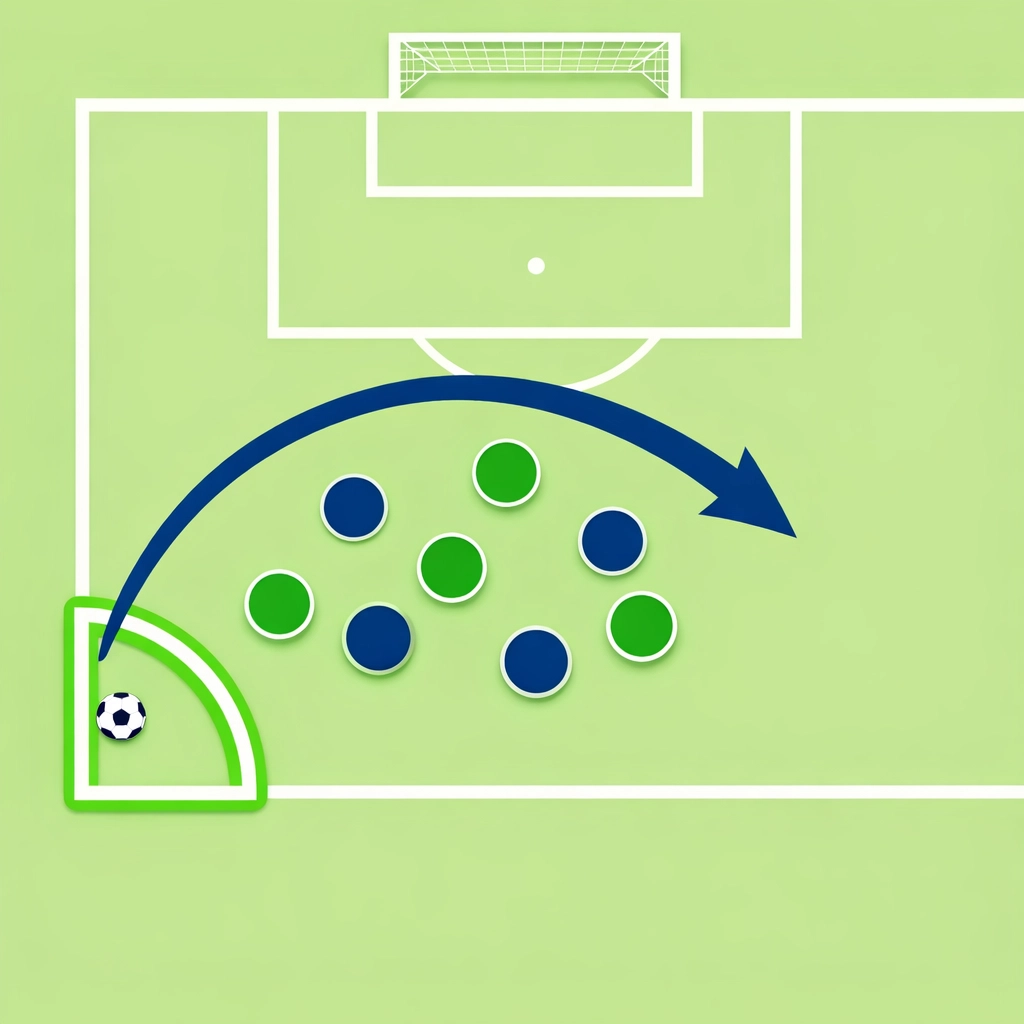
Some traders lay a short-priced favourite when it has to defend a corner or a dangerous free-kick, hoping for a goal against it.
At low prices the liability is small: laying £10 at 1.25 risks £2.50 if the favourite goes on to win. If the underdog scores, the favourite’s price drifts and you can close the trade in profit; if the set piece comes to nothing, you can close it for a small loss. One corner isn’t a reason on its own, so look at how the whole match is going first.
As the match reaches the 70th or 80th minute, the odds for “Over 0.5 Match Goals” or “Next Goal” start to move very quickly.
Start with the base rate. Up to 26 October 2026, 361 of the 688 league matches in those eight leagues (52.5%) had a goal after the 75th minute, from 38.3% in the Scottish Premiership to 65.1% in the Bundesliga (our in-play scanner guide has a league-by-league table to 19 October). Live pressure stats can tell you whether a match is busier than that average, but they can’t make a goal certain, and if the goal doesn’t come, the price on another goal keeps drifting as the clock runs down. Decide your exit before you enter. The in-play tips page shows live matches.
If you’re watching a game on a standard live stream, you are likely 20 to 30 seconds behind reality. In the trading world, that’s an eternity.
If you see a goal on your TV and try to trade, the market will already be suspended. You’ve missed it.
This is why it pays to check live data rather than trust your eyes alone. Footy Amigo’s in-play alerts are sent to your phone when a match meets your rules, but no data feed is instant, so treat a sudden price move or a suspended market as a sign that something has already happened. Our guide on how to integrate in-play alerts with Betfair goes into more detail.
I’ll be blunt: most people fail at football trading not because they can’t find a winner, but because they have the discipline of a toddler in a sweet shop.
Trading is about staying in the game.

The biggest hurdle for most traders is time. You can’t sit in front of a screen for 12 hours a day watching the Bulgarian second division.
This is where alerts and the Amigo Copier come in.
Say your rule is “0-0 at 60 minutes, and the pre-match favourite was priced under 2.0”. Set it up as a Footy Amigo in-play alert and you’ll be notified on your phone when a match meets it, instead of watching every game. The Amigo Copier lets you view, clone and copy other users’ pre-match and in-play strategies into your own account, and you can track the hit rate of any alert over time.
You still place every bet or trade yourself, so the decision to enter, and when to exit, stays yours.
Football trading is a journey, not a sprint. You’ll start as a beginner, likely making the mistake of chasing losses or trading without data. But as you start using tools like Footy Amigo, you’ll realise that the “magic” is actually just statistics and discipline.
What we’ve covered:
Whether you are looking for predictions for today’s football or trying to build a complex multi-market system, the key is consistency.
One Practical Tip to Remember:
Next time you’re watching a game, don’t just look at the score. Look at the pressure too. If a team is trailing but piling on dangerous attacks, ask whether the price already reflects that before you act.
Ready to stop guessing? See FootyAmigo plans and start your 5-day free trial
18+ only. Trading and betting carry risk: only stake what you can afford to lose. These statistics describe past matches and don’t guarantee future results. Footy Amigo is committed to supporting Responsible Gambling | www.gambleaware.co.uk