

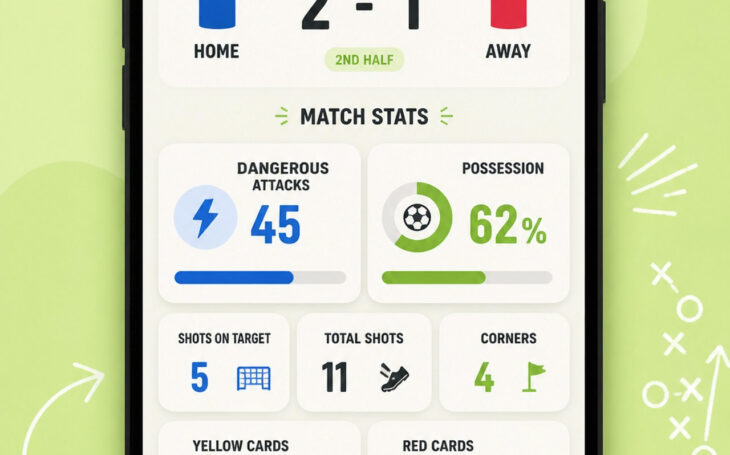
Right, let’s have a proper chat about in-play football trading. If you’ve ever sat at the pub, watching a match where one team is absolutely battering the other, and thought, “There’s a goal coming here,” then you’ve already got the basic instinct for trading.
But there’s a massive difference between having a “hunch” and actually making consistent profit. Most punters treat in-play betting like a trip to the casino: they see a bit of pressure, throw a tenner on “Next Goal”, and hope for the best. That’s not trading; that’s just guessing with extra steps.
In-play trading is about using real-time data to spot when the bookies have got the odds slightly wrong. It’s about entering and exiting the market at the right time to lock in a profit, regardless of how the match actually ends.

If you’re tired of losing your shirt because a 90th-minute equaliser ruined your accumulator, you’re in the right place. Let’s break down how to stop betting like a fan and start trading like a pro.
Before we dive into the deep end, we need to clear something up. Most people think “trading” is just a fancy word for “betting while the game is on.” It isn’t.
When you place a standard bet, you’re stuck. You put your money down, and you wait for the whistle. If your team wins, you get paid. If they don’t, you lose. It’s binary.
Trading is more fluid. You’re looking to “back” (bet for something to happen) and then “lay” (bet against it happening) as the odds move. Or vice-versa. Your goal isn’t necessarily to predict the final score, but to predict market movement.
Think of it like buying a car for £5,000 because you know it’s actually worth £7,000, and then selling it an hour later. You don’t care who ends up driving the car; you just care about that £2,000 gap. In football, that “gap” is created by the clock, goals, red cards, or just sheer pressure on the pitch.

Why bother with all this extra effort? Why not just stick to pre-match bets?
The problem with pre-match betting is that you’re guessing based on what might happen. Once the whistle blows, everything changes. A star striker could pull a hamstring in the first five minutes, or a heavy downpour could turn the pitch into a swamp.
In-play trading allows you to react to reality.
By using tools like an in-play scanner, you can see exactly how the game is unfolding. Is the underdog actually dominating possession? Is the favourite struggling to get a single shot on target? This is where the value lives. The bookies use complex algorithms, but even they can’t always account for the “eye test” backed up by hard stats.
If you haven’t read it yet, our guide on the maths of losing explains exactly why betting without data is a fast track to an empty wallet. In-play trading is the antidote to that.
You don’t need to be a data scientist to trade well, but you do need to know which numbers to ignore. Forget “Possession Percentage”: it’s often a trap. A team can have 70% possession by passing the ball between their centre-backs while doing absolutely nothing.
Instead, focus on these “Pulse Stats”:
This is the big one. A “Dangerous Attack” is usually defined as an attack where the team enters the final third of the pitch. If Team A has 15 Dangerous Attacks in 10 minutes and Team B has zero, Team A is knocking on the door.
You can’t score if you don’t hit the target. It sounds simple, but watching the ratio of shots to goals is vital. If a team has 10 shots on target but the score is still 0-0, the odds for “Over 0.5 Goals” are likely to be much higher than they should be.
Corners are often a sign of sustained pressure. If a team wins three corners in five minutes, it means they are pinning the opposition back. This is often the perfect time to look for a momentum trade.

You don’t need a massive playbook to start. In fact, most successful traders stick to one or two setups and master them. Here are two that are perfect for beginners:
Many matches start tentatively. Managers spend the first 15 minutes feeling each other out.
This is for the games where a favourite is drawing 0-0 or 1-1 at the 70th minute.

Let’s be honest: you can’t watch 50 matches at once. If you’re trying to find the best trading opportunities manually, you’re going to miss 90% of them.
This is where an in-play scanner becomes your best mate. Instead of you hunting for games, the scanner does the legwork. You set the rules: for example, “Alert me when a game is 0-0 after 60 minutes and the home team has had 5 shots on target in the last 10 minutes”: and your phone pings the second it happens.
It’s like having a personal assistant who never sleeps and has a photographic memory for football stats. It levels the playing field against the bookies.
For those who aren’t quite ready to build their own strategies yet, features like the Amigo Copier let you see what other traders are doing. It’s a great way to learn the ropes without feeling like you’re flying blind.
The quickest way to blow your bankroll is to “chase” a loss. We’ve all been there. You lose a trade at 3:00 PM, and by 4:00 PM, you’re putting double the money on a random game in the Mongolian second division just to “get back to even.”
Stop. Just stop.
Pro traders treat their bankroll like a business.
In-play football trading isn’t a “get rich quick” scheme. It’s a skill that takes time to hone.
Start small, use the tools available to you, and focus on the process rather than the profit. If the process is right, the profit usually follows.
Practical Tip to Remember:
Always check the “Liquidity” of a market before entering. If there isn’t much money being traded in a specific league, you might find it hard to “exit” your position when you want to. Stick to the big leagues (Premier League, La Liga, Bundesliga) while you’re still learning the ropes!
[…] and towards becoming a disciplined trader. If you’re ready to get started, check out our Ultimate Guide to In-Play Football Trading for more advanced entry […]