



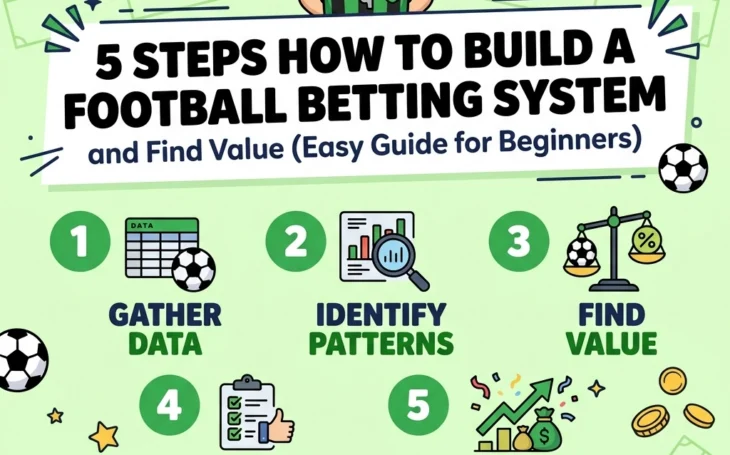
Football Betting System; let’s be honest for a second: most of us started betting because we “had a feeling.” You know the one. You’re sat on the sofa, looking at the Saturday fixtures, and you think, “Liverpool are definitely going to smash Leeds today, I just feel it in my waters.” You place the bet, Liverpool draw 0-0, and your “waters” have officially lied to you.
The truth is, the bookies love your feelings. They build massive glass skyscrapers in London off the back of people’s “feelings.” If you want to actually stand a chance of coming out on top in the long run, you need more than a hunch. You need a system.
Learning how to build a football betting system isn’t about becoming a maths genius or living in a dark room full of monitors like a low-budget Bond villain. It’s about discipline, data, and finding that elusive thing called “value.”
Here is a dead-simple, 5-step guide to building your first system without losing your mind (or your shirt).
Before we even look at a single match, we have to talk about money. I know, I know, boring, right? But listen, if you don’t manage your bankroll, you aren’t “investing” or “trading,” you’re just donating to the bookies’ Christmas party fund.
First, decide on a Bankroll. This is an amount of money you are 100% comfortable losing. It should be separate from your rent, your grocery money, and your “going to the pub” fund.
Next, you need to determine your Unit Size. This is the amount you’ll bet on every single game.
Why 1%? Because football is weird. Even the best football betting systems in the world will hit a losing streak. If you bet 20% of your bankroll on one “certainty” and it loses, you’re in trouble. If you bet 1% and it loses, you’ve still got 99 chances to make it back.

If there is one thing you take away from this post, let it be this: Value is the only thing that matters.
Value happens when the probability of an event occurring is higher than what the bookmaker’s odds suggest.
Think of it like a coin toss. Heads is 50%, Tails is 50%. In “fair” odds, that’s 2.00 (Evens). If a bookie offered you odds of 2.50 on Heads, that’s value. It doesn’t mean Heads will win every time, but if you take that bet 1,000 times, you’re going to be very, very rich.
To find value in football betting, you need to start making your own “fair” prices.
If the bookmaker is offering odds of 1.80, you’ve found value! If they are offering 1.50, you walk away, even if you’re “sure” Arsenal will win. Betting on 1.50 when the true value is 1.67 is how you lose money long-term.
Don’t try to be an expert on every league in the world. You don’t need to know the bench strength of the Peruvian second division.
Pick a niche. Maybe you’re the king of Over 1.5 Goals tips or perhaps you’ve got a knack for spotting Over 4.5 First Half Corners.
When building your system, look for specific “Conditions.” This is where Footy Amigo makes your life incredibly easy. Instead of spending six hours on spreadsheets, you can set “Smart Alerts” based on data like:
Base your decisions on what has happened (data), not what you hope will happen (emotion).

The goal of a system is to remove the human element. If your system says “Bet on the draw in the Italian Serie B because the data fits,” you bet on it. Even if your gut says “Ugh, Italian football is boring.” The data doesn’t have a “gut,” and the data doesn’t get hungover.
Look, we aren’t robots. Sometimes our probability estimates are a bit… optimistic. To combat this, smart bettors use a “Safety Factor.”
If your calculated “fair odds” for a Sure Home Win prediction are 1.50, don’t just bet on anything over 1.50. Add a 10% buffer. Only take the bet if the bookie offers 1.65 or higher.
This buffer protects you from your own mistakes and from those “freak” occurrences: like a star striker twisting his ankle in the warm-up or a referee having an absolute nightmare of a game.
This is the part where most people fail. They place three bets, lose two, and say, “This system is rubbish!”
A system needs a “Sample Size.” You need to track at least 50–100 bets before you can even begin to judge if it’s working.
Before you put your hard-earned cash on the line, you should ideally see how your system would have performed in the past. This is called backtesting.
Why guess when you can know? Why backtesting your football betting systems will change the way you handle losing streaks is a huge topic, but essentially, it gives you the confidence to stick with a strategy even when you hit a few losers.
Keep a log (a simple spreadsheet or even a notebook) of:
After a month, look at the data. Are you crushing it in the Premier League but losing money on the Bundesliga? Great! Drop the Bundesliga and focus on what’s working. That is how you evolve from a gambler into a smart bettor.

Even with a system, the “Inner Gambler” will try to sabotage you. Watch out for these:
Building a football betting system isn’t a “get rich quick” scheme. It’s a “don’t get poor quickly” scheme that eventually leads to steady, long-term growth.
It takes the stress out of Saturday afternoons. No more frantic scrolling through Twitter looking for “tips.” No more panic-betting on a random game in the 80th minute because you’re bored. Just a calm, data-driven approach to the game we love.
Practical Tip for Today:
Start a betting log today. Even if you aren’t using a full “system” yet, record every bet you make for the next week. At the end of the week, look at how many of those bets were based on actual stats and how many were “feelings.” The result might surprise you!
Ready to stop guessing and start using data? Check out how it works at Footy Amigo and let us do the heavy lifting for your next system.
[…] Footy Amigo, we’re obsessed with the 5 steps on how to build a football betting system. For trading, those steps are even more vital. You need to […]
[…] If you’re not sure how to start building a system worth tracking, check out our 5 steps on how to build a football betting system. […]