



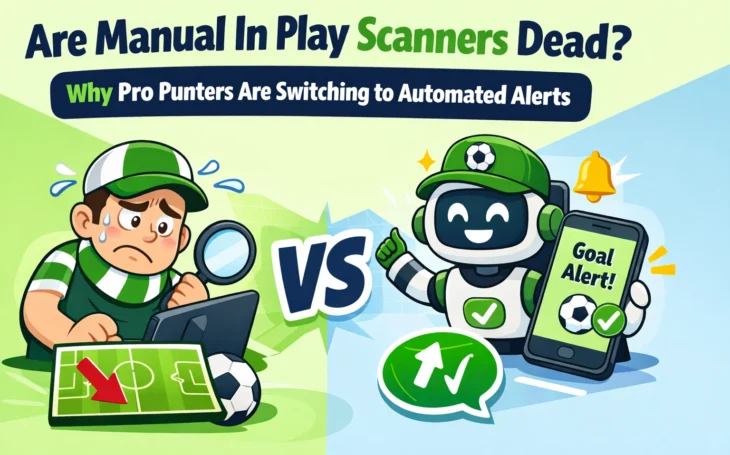
Automated Alerts; picture this: It’s Saturday afternoon, 3:00 PM. You’ve got the laptop open with eighteen different tabs. You’re toggling between three different live-score apps, a betting exchange, and a dodgy stream of a League One match that keeps buffering every time someone gets near the box. Your eyes are darting around like you’re watching a championship-level ping-pong match, and your morning coffee has gone cold because you’re too scared to look away for thirty seconds.
Sound familiar? This is the life of the “manual scanner.” It’s exhausting, it’s stressful, and quite frankly, it’s a bit old-school.
In the world of football betting, things move fast. A striker goes down with a hamstring tweak, a red card flips the odds on their head, or a team suddenly starts peppering the goal with shots. If you’re manually checking games, you’re already behind. By the time you’ve refreshed your page and calculated the value, the odds have shifted, the value has evaporated, and you’re left chasing shadows.
So, are manual in-play scanners dead? For the serious pro punter, the answer is a resounding “yes.” Let’s look at why the smart money is moving toward automated alerts and how you can stop working harder and start betting smarter.
We like to think we’re sharp. We think we can spot a “goal in the air” just by looking at a stats table for a few seconds. But here’s the cold, hard truth: the human brain isn’t built to process live data from 40 different matches across the globe simultaneously.
When you’re manually scanning, you’re prone to something called “confirmation bias.” You want to find a game that fits your “Over 2.5 Goals” strategy, so you subconsciously ignore the facts that tell you the match is actually a bit of a snooze-fest. You see a high corner count and think “they must be attacking,” but you miss the fact that both teams have stopped running since the 60th minute.
Automated alerts don’t have feelings. They don’t get tired, they don’t get bored, and they don’t have a “hunch” because they once saw that striker score a worldie three seasons ago. They look at the raw data: shots on target, dangerous attacks, ball possession: and tell you exactly when a match hits your specific criteria.
As we’ve discussed before in our look at scanners vs. gut feelings, relying on your eyes alone is the quickest way to empty your bankroll.

In the time it took you to read that last paragraph, a pro punter’s automated alert could have triggered, been reviewed, and had a bet placed.
Research shows that automated systems can update odds and detect patterns within milliseconds. Humans? We’re lucky if we can click a button in under two seconds. In the fast-paced world of in-play betting, those seconds are the difference between grabbing a price of 2.10 or being stuck with 1.80 after the market adjusts.
If you’re still clicking “refresh” on a browser tab, you’re effectively racing a Ferrari on a bicycle. You might feel like you’re moving fast, but the competition is already across the finish line. Professional betting is about finding value, and value is a fleeting thing. Automation ensures you catch it the moment it appears, not three minutes after the rest of the market has already reacted.
Think of it like being at the pub. You want to buy a round, but there are fifty people at the bar. If you’re manual scanning, you’re standing at the back of the queue, hoping the barman sees you. If you’re using automated alerts, you’ve basically got a direct line to the tap and a reserved spot. Which one sounds more profitable (and less annoying)?
Let’s say you have a cracking strategy for first half over 0.5 goals. On a busy Saturday, there might be 200 matches kicking off across Europe at the same time.
How many of those can you realistically track manually? Three? Maybe five if you’ve had enough caffeine?
By limiting yourself to what you can physically watch or click on, you’re leaving a massive amount of profit on the table. There might be a perfect setup happening in the Austrian Second Division or the Victoria Premier League 2 that fits your criteria perfectly, but you’ll never see it because you’re too busy watching a 0-0 draw in the Championship.

Automated alerts allow you to scale your brain. You set the rules: “Send me a Telegram alert when a game is 0-0 at 30 minutes, with more than 10 dangerous attacks and at least 3 shots on target”: and the software does the “grunt work” for you. It scans thousands of live markets every single second.
This isn’t just about betting more; it’s about betting better. You’re only seeing the cream of the crop: the games that actually deserve your money.
Most people lose at betting because of poor discipline and even poorer data. We’ve covered why most punters lose before, and a big part of it is “panic betting.”
When you’re manual scanning and you haven’t found a bet in two hours, you start to get itchy fingers. You force a bet on a game that doesn’t quite fit your criteria just because you want some “action.”
Automation removes the “action” trap. If no games hit your criteria, your phone stays silent. You don’t bet. You don’t lose money on rubbish games. You wait for the alert that actually means something. It turns you from a gambler into a cold-blooded analyst.
At Footy Amigo, we don’t want to just give you a list of tips. We want you to understand the why behind the win. Using automated alerts is like setting a net in the right part of the river. You still have to decide which fish to keep, but at least you aren’t standing in the water with a spear in the dark.

If you’re ready to ditch the 50 open tabs and start using your head, here’s how to transition to automated alerts properly:
For the casual fan who just wants a flutter on the weekend while watching the telly, manual scanning is fine. It’s a hobby. But if you’re looking to treat football betting like a serious side-hustle or a professional endeavour, manual scanning is a relic of the past.
The pros have moved on. They use speed, scale, and automation to find value in corners of the market you’ll never see through a browser window. They aren’t smarter than you; they just have better tools.
It’s time to stop shouting at the screen because you missed a goal by ten seconds. It’s time to let the bots do the heavy lifting while you focus on the strategy.

**The “Rule of Three”:** Before you set an automated alert, ensure your strategy relies on at least three correlating stats. For example, don’t just look for “Shots on Target.” Look for “Shots on Target” + “Dangerous Attacks” + “Time since last goal.” This creates a much more accurate picture of game momentum than any single stat ever could. Better data equals better alerts, and better alerts equal a healthier bankroll!