

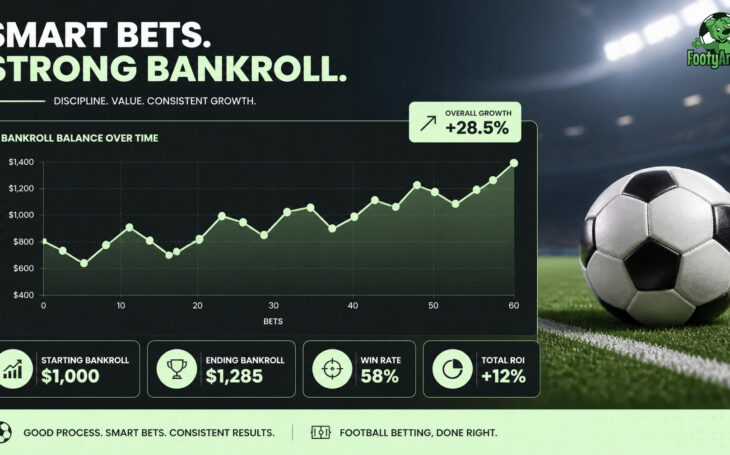
Bankroll Management; we’ve all been there, haven’t we? You’ve had a cracking weekend on the football. You’ve landed a sweet 5/1 winner, your in-play strategy is firing, and you feel like the next Tony Bloom. You’re already looking at that new telly or thinking about booking a holiday with the winnings.
Then, Monday comes around. A “dead cert” in the Icelandic second division lets you down, and suddenly you’re chasing. By Wednesday, half those weekend winnings are gone. By Friday? You’re depositing more cash just to get back to where you started.
If that sounds familiar, don’t worry: you’re not alone. In fact, most punters lose not because they can’t pick a winner, but because they have absolutely no idea how to manage their money. In the world of professional betting, we call this bankroll management. It’s not the sexiest topic: it’s not as exciting as a last-minute winner in the Champions League: but it is the single most important skill if you want to stop donating to the bookies and start winning consistently.
Before we dive into the maths, let’s get the basics right. Your bankroll is a dedicated pot of money used strictly for betting.
It’s not your rent money. It’s not the money for your kid’s new trainers. It’s money that you have mentally (and physically) set aside for your football trading. If you’re still “topping up” your account £20 at a time whenever you fancy a flutter, you don’t have a bankroll: you have a costly hobby.
Professional punters treat their bankroll like a business fund. If the fund runs out, the business closes. By separating your betting cash from your “life” cash, you remove the emotional weight of a loss. When you lose a bet using money you need for the grocery shop, you panic. When you panic, you make bad decisions.

Here is a hard truth: you can be the best football analyst in the world and still lose ten bets in a row.
This is called variance. Football is a game of fine margins. A VAR decision, a red card in the 5th minute, or a striker hitting the post can turn a “perfect” bet into a loser. Over 1,000 matches, the best team usually wins. Over 90 minutes? Anything can happen.
Most punters fail because they don’t account for the maths of losing. If you are betting 10% of your bankroll on every match, a run of ten losers: which is statistically very possible: wipes you out completely. Game over.
By understanding that variance is part of the game, you stop taking losses personally. You realize that a losing streak isn’t a sign that your strategy is broken; it’s just the natural ebb and flow of probability. The goal of bankroll management is to make sure your bankroll is big enough to survive the “red” periods so you’re still standing when the “green” returns.

Once you’ve got your bankroll, you need a plan for how much to bet on each game. This is your staking plan. There are two main ways to do this, and both are better than just “guessing.”
This is the simplest method. You decide on a “unit” size (usually 1% or 2% of your total bankroll) and you bet that exact amount every single time.
If you have a £1,000 bankroll and your unit is 1%, you bet £10 on every game. Whether you’re on a winning streak or a losing streak, you stick to £10. This is brilliant for discipline because it stops you from “pressing” (increasing stakes) when you’re feeling overconfident.
This is a bit more advanced and is what many pros use to grow a bankroll faster. Instead of a fixed amount, you bet a percentage of your current balance.
Let’s say you start with £1,000 and bet 2% (£20). You win, and your balance is now £1,050. Your next bet is 2% of £1,050, which is £21. If you lose and your balance drops to £900, your next bet is 2% of £900, which is £18.
This method has a built-in safety net: when you’re losing, your stakes get smaller to protect your capital. When you’re winning, your stakes increase to take advantage of compounding.

If there is one piece of advice you take away from this, let it be this: stop over-staking.
The biggest mistake casual bettors make is betting too much of their bankroll on a single match. They see a “sure thing” and put 20% of their pot on it. In the long run, this is financial suicide.
Professional bettors rarely risk more than 1% to 2% on a single selection. Why? Because they know that to survive in this game, you need to be able to handle a brutal drawdown. If you risk 1% per bet, you need to lose 100 times in a row to go bust. If you risk 10%, you only need a bad week to lose everything.
Think of your bankroll like a shield. The smaller your stakes relative to the total pot, the thicker the shield.
We’ve all felt that sting. You’ve lost three bets in a day, you’re annoyed, and you see a late-night game in Brazil. You think, “If I just put a double-stake on this, I’ll be back to even for the day.”
This is called chasing losses, and it is the fastest way to the poorhouse. When you chase, you aren’t betting based on data or value; you’re betting based on wounded pride.
The bookies love chasers. Chasers make emotional decisions. Chasers ignore their own rules. A professional punter accepts the loss, closes the laptop, and waits for the next high-probability setup. They know their edge will play out over the next 100 bets, so one bad day doesn’t matter.
One of the hardest parts of bankroll management is the manual work: tracking your bets, calculating percentages, and staying objective. This is where using a tool like Footy Amigo becomes a game changer.
Instead of guessing which games to bet on, you can use Smart Match Alerts to only get notified when a game meets your specific, data-driven criteria. By removing the “gut feeling,” you naturally become more disciplined with your stakes.
If you’re struggling to build a strategy that actually works, the Amigo Copier is a fantastic place to start. It allows you to clone strategies from other punters for free.
Furthermore, having access to 14+ years of historical data means you can backtest your ideas. You can see exactly how a 10-game losing streak would have affected your bankroll before you risk a single penny of real money. That kind of peace of mind is priceless.
Football betting is a marathon, not a sprint. If you’re looking to get rich by next Tuesday, you’re in the wrong place. But if you want to build a sustainable, profitable side-hustle (or even a career), you have to master your money.
Treat your bankroll with respect. Track every penny. Stay disciplined when the variance hits.
Practical Tip: Start a simple spreadsheet today. Record your starting bankroll, every bet you place, the stake, the odds, and the outcome. At the end of the month, look at your ROI (Return on Investment) rather than just the profit figure. If your ROI is positive, you’ve got a winning process: all you need is the patience to let it grow.
[…] This strategy is perfect for those who want to practice bankroll management while enjoying the thrill of the final whistle. You can read more about managing your funds in our guide to mastering bankroll management. […]
[…] If your system shows a positive ROI over 500 games, you have something worth pursuing. If it loses money over a large sample size, you’ve just saved yourself a lot of cash by not betting it live. You can learn more about how to handle your funds during this phase in our guide to Mastering Bankroll Management. […]