



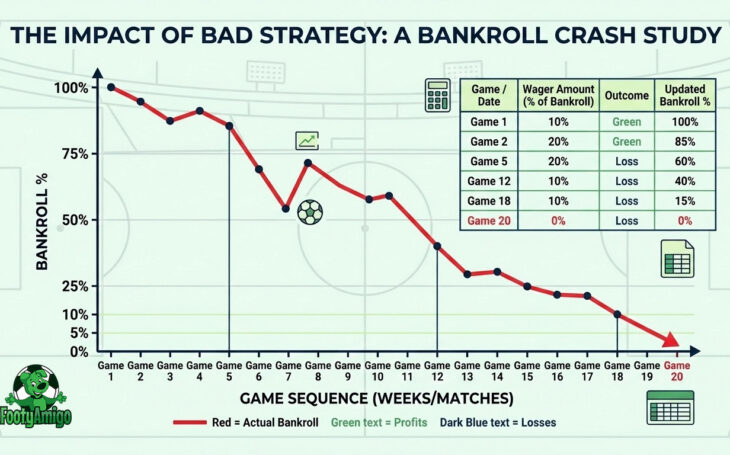
Football Betting; we’ve all been there. It’s Saturday afternoon, you’re looking at the fixture list, and you see a match that just feels right. Maybe it’s a top-four side playing away at a struggling underdog, or perhaps you’ve got a “sneaky feeling” that a certain striker is due a goal. You place the bet, convinced that your footballing intuition is sharp enough to outsmart the bookmakers.
But here is the cold, hard truth: football betting on a “hunch” is the fastest way to empty your bankroll.
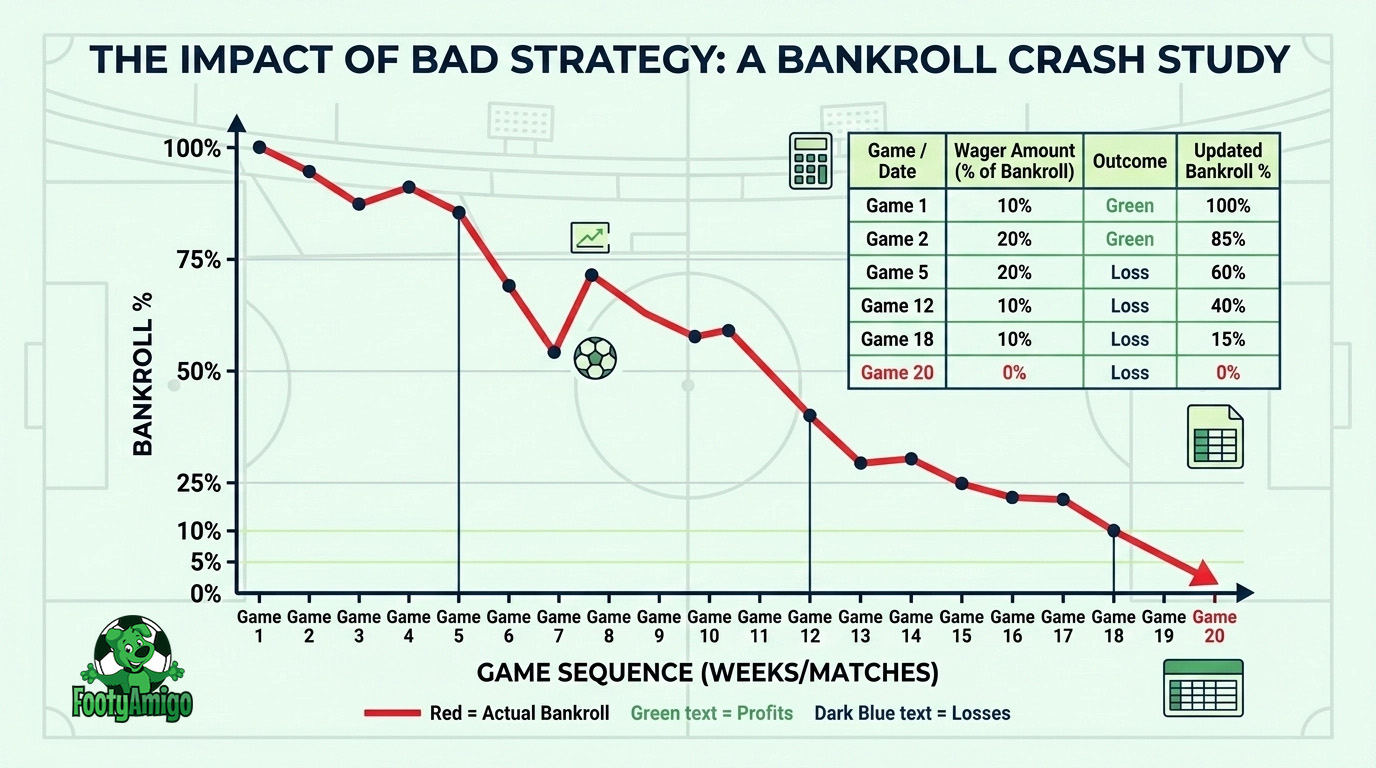
In the world of football betting, emotions are the enemy and data is your only real ally. The bookmakers don’t set their odds based on “feelings”: they use sophisticated algorithms, massive datasets, and a built-in mathematical advantage to ensure they win in the long run. If you aren’t using the same level of intelligence, you aren’t really betting; you’re just donating your hard-earned cash to the bookies.
In this post, we’re going to pull back the curtain on the maths of losing. We’ll explore why your gut is lying to you, how the “overround” works against you, and why data-driven decisions are the only way to level the playing field.
Before the ball is even kicked, the deck is already stacked against you. This isn’t because of some grand conspiracy, but because of a simple mathematical concept called the overround (also known as the “vig” or the “juice”).
Imagine a simple coin flip. In a fair world, the odds for Heads or Tails would be 2.00 (Evens). If you bet £10 on Heads and win, you get £20 back. If you lose, you lose £10. Over 100 flips, you’d likely break even.
However, a bookmaker doesn’t offer 2.00. They might offer 1.90 for Heads and 1.90 for Tails. If you bet on both, you’ve spent £20 to “win” back £19. That £1 difference is the bookie’s profit margin. In football betting, this margin is hidden across the Home Win, Draw, and Away Win markets.
When you bet based on a gut feeling, you are rarely accounting for this margin. To break even at odds of 1.90, you need to win 52.6% of your bets. To make a profit, you need to be even more accurate. Most casual punters have a win rate that hovers around 45-48%, which is exactly where the bookies want you.
Without data, you can’t tell if the odds you’re taking actually represent value. You might think a team has a 50% chance of winning, but if the bookie has priced them at 1.80, you are mathematically guaranteed to lose money over time.

If there is one term you need to tattoo on your brain, it’s Expected Value (EV). Professional bettors don’t care if a single bet wins or loses; they care if the bet has Positive Expected Value (+EV).
Expected Value is a calculation that tells you how much you can expect to win or lose per bet if you placed the same bet hundreds of times.
The formula is simple:
(Probability of Winning × Amount Won per Bet) – (Probability of Losing × Amount Lost per Bet)
If the result is positive, it’s a “good” bet. If it’s negative, it’s a “bad” bet: even if it ends up winning!
The problem is that gut feelings are terrible at estimating true probability. You might think a team is a “dead cert,” but data might show they struggle against high-pressing teams or have a poor record in away games following a midweek European fixture.
By using tools like Smart Match Alerts, you stop guessing and start identifying matches where the statistical probability of an outcome is higher than what the bookmaker’s odds suggest. That is where the profit lives.
One of the cruelest parts of football betting is that you can do everything wrong and still win in the short term. This is called variance (or, more simply, luck).
A casual bettor might win five games in a row using nothing but their “football knowledge”. This creates a dangerous sense of false confidence. They think they’ve “cracked the code”, so they increase their stakes. But because their process isn’t based on data, the law of large numbers eventually catches up with them.
Variance is the reason why many people think they are better at betting than they actually are. Small sample sizes can make almost anything happen. A last-minute penalty or a deflected shot can turn a “bad” bet into a winner.
However, over 200, 500, or 1,000 bets, luck evens out. Only those with a data-driven edge will remain profitable. This is why historical data and backtesting are so vital. If you can see that your strategy would have been profitable over the last 12 months across 1,000 matches, you can be confident that you have a real edge, not just a lucky streak.

As humans, we aren’t built for objective probability. Our brains are full of “shortcuts” that lead to poor betting decisions. Here are the three biggest offenders:
Data removes these biases. An AI-powered analytics tool doesn’t care about a team’s “prestige” or how you felt about them last season. It only cares about the numbers.
So, how do you stop being the “donation” the bookies rely on? You have to move from being a “punter” to being a “trader”. You need to treat your betting like a business, and every business needs data.
Footy Amigo was built to give the average person the same power that the big bookmakers have. Instead of spending hours scrolling through stats websites and trying to remember which teams are good for corners, you can automate the entire process.

You can continue to bet with your gut, enjoy the occasional win, and wonder why your balance always hits zero by the end of the month. Or, you can embrace the maths.
Winning at football betting isn’t about knowing everything about football; it’s about understanding probability and having the discipline to stick to a data-driven process. The bookies want you to be emotional. They want you to chase losses and bet on the “big games” without checking the stats.
Don’t give them what they want. Start using the data, start thinking in terms of Expected Value, and let the maths work for you instead of against you.
Next time you feel a “hunch” coming on, stop. Write down the three statistical reasons *why* that bet is a good idea. If you can’t find data to support it (e.g., historical head-to-head, current form, or xG trends), **do not place the bet.** Your bankroll will thank you.

[…] you haven’t read it yet, our guide on the maths of losing explains exactly why betting without data is a fast track to an empty wallet. In-play trading is […]