

Data-driven; Let’s be honest for a second. We’ve all been there, sitting on the sofa on a Tuesday night, watching a random Belgian Pro League match, and thinking: “I just have a feeling there’s a goal coming here.” You open your betting app, stick a tenner on Over 0.5 Goals, and watch in horror as the match ends in a stale 0-0 draw.
That “feeling” is the enemy. It’s the reason why the vast majority of punters end the year in the red. The bookies love your gut feelings because your gut doesn’t have access to 14 years of data. If you want to stop being the bookmaker’s favorite customer and start treating your betting like a serious side hustle, you need a blueprint.
In this guide, we’re going to bin the “gut feelings” and look at how to build a data-driven strategy that keeps your bankroll healthy and your decisions sharp.
Most people don’t lose at football betting because they don’t know football. They lose because they are human. Our brains are hardwired to look for patterns where they don’t exist and to chase excitement. This is what we call emotional betting.
When you bet because you’re bored, because your team is playing, or because you’re trying to “win back” the money you lost on the early kick-off, you’ve already lost. The bookies use complex AI technology to set their prices. If you’re fighting back with nothing but “vibes” and a pint in your hand, you’re bringing a plastic knife to a gunfight.
The problem with a “hunch” is that it’s usually based on recency bias. You saw Liverpool score four goals last week, so your gut tells you they’ll do it again today. But your gut isn’t factoring in the midweek travel, the injury to their key defensive midfielder, or the fact that the opposition has a 65% win rate when playing at home against top-six sides.
To win consistently, you have to separate the emotion of being a fan from the cold, hard logic of being a trader. You need to move away from “who will win” and start asking “where is the value?”

Before you even think about looking at a match, you need to sort your bankroll management. This is the most boring part of betting, but it is also the most important. Without a proper staking plan, even the best strategy in the world will eventually go bust during a natural run of variance.
Think of your bankroll as your business capital. If you were running a coffee shop, you wouldn’t spend your entire month’s rent on a “feeling” that lattes will be popular on Thursday. You’d be careful. You’d manage your operating costs.
A professional approach usually involves the 1% rule. This means you never bet more than 1% of your total bankroll on a single selection. If you have £500 set aside for betting, your standard stake should be £5.
Why so small? Because football is unpredictable. Even a “sure thing” with a 90% probability will lose 10 times out of 100. If you’re staking 20% of your bankroll on every match, a short losing streak will wipe you out before your luck has a chance to turn. By sticking to small, consistent units, you ensure that you stay in the game long enough for the maths to work in your favour.

If you want to know if a strategy actually works, you don’t test it with your own money in real-time. You use Historical Data & Backtesting.
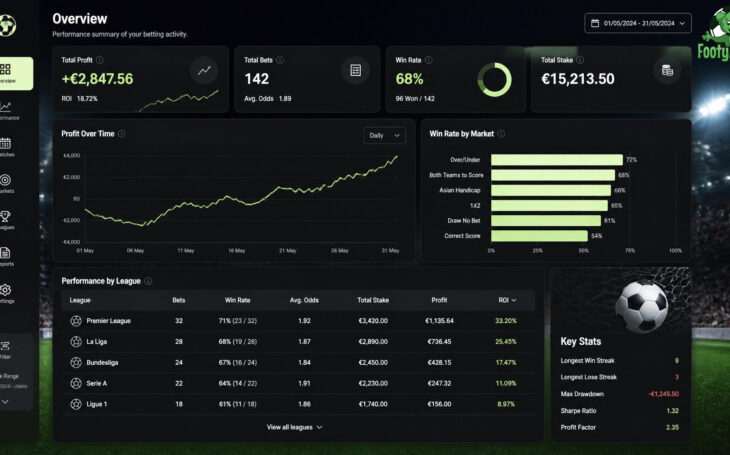
Most punters find a “system” (like betting on Over 2.5 goals in the Eredivisie) and just start punting. A smart punter uses a tool like Footy Amigo to look back at the last 12 months of data. Does that strategy actually make a long-term profit? Or does it just feel like it does because you remember the wins and forget the losses?
When you backtest, you’re looking for a statistical edge. You might discover that betting on “Both Teams to Score” in the German Bundesliga yields a 12% ROI over 500 games, but only when the home team is in the bottom half of the table.
This is where the magic happens. Instead of guessing, you’re using machine learning algorithms to identify patterns. You aren’t betting on the game; you’re betting on the probability.

The biggest difference between a loser and a winner is the amount of manual research they do. Or rather, how they automate that research. Smart punters don’t spend six hours a day looking at spreadsheets; they set up Smart Match Alerts.
Imagine having a personal assistant that monitors 1,800+ leagues around the clock. When a match meets your specific, data-proven criteria, say, the score is 0-0 at 60 minutes but there have been more than 10 shots on target, you get a notification on your phone.
In-play alerts are a game-changer. They allow you to react to what is actually happening on the pitch rather than what you thought would happen before kick-off. If a heavy favourite is trailing 1-0 but dominating every stat, the “Value” is often on them to come back and win or draw.
By using real-time data, you’re making decisions based on facts, not the pre-match hype. This is how you level the playing field against the bookmakers. If you’re looking for inspiration, you can even use the Amigo Copier to see what profitable strategies other successful users are running.
To stop losing, you need to implement a “filter” for every selection. Before you place a bet, run it through this simple three-step checklist:
If the answer to any of these is “no,” you keep your money in your pocket. It’s better to miss a winning bet than to place a stupid one.
The journey from a losing punter to a savvy bettor isn’t about finding a “secret tipster” or a “fixed match.” It’s about discipline and data.
By treating your betting like a business: logging every trade, managing your bankroll, and using powerful analytics tools: you remove the volatility of human emotion. You won’t win every bet, and you will still have bad weekends. But over the course of a season, the data doesn’t lie.
Practical Tip: Start a betting log today. Every time you place a bet, write down why you did it. At the end of the month, highlight every bet that was based on a “feeling” or “hunch.” Calculate how much money those specific bets cost you. The number will likely shock you into becoming a data-driven punter for good.
[…] With a tool like Footy Amigo, you don’t have to go looking for the data; the data comes to you. You can set up a “Smart Alert” that scans thousands of games across 1,800+ leagues. […]
[…] you’ve done your research using a tool like Footy Amigo’s historical data and your data suggests the team actually wins 60% of the time, but the odds are 2.00 (implying […]
[…] the bookmakers rely on to keep their profits high. To start winning, you need to understand the how to stop losing at football betting blueprint, which begins with removing emotion from the […]
[…] the same outcome, but your profit margin has nearly doubled. This is the first step in learning how to stop losing at football betting and starting to treat your bankroll with […]