



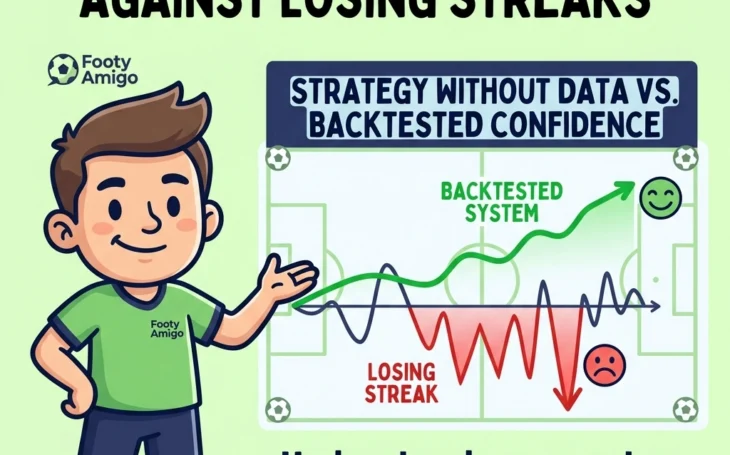
Losing Streaks; picture this. You’ve spent a couple of hours looking through stats, you’ve spotted a pattern, maybe it’s late goals in the Bundesliga or Over 0.5 First Half goals in the Dutch Eerste Divisie, and you decide to turn it into a strategy.
Monday comes. Your first bet loses. No big deal, right?
Tuesday. Two more bets, two more losses. You start to sweat.
Wednesday. A “certainty” in the Champions League goes south in the 90th minute.
By Thursday, you’re convinced the universe is conspiring against you. You delete the strategy, call the bookies every name under the sun, and go back to blindly picking teams based on “gut feeling” (which usually just means picking the team with the nicer kit).
This is the cycle most punters live in. It’s a rollercoaster of emotions that leads to bad decisions, chased losses, and a drained bankroll. But what if I told you there’s a way to look at a five-match losing streak and actually smile because you knew it was coming?
That is the power of backtesting.
The biggest reason punters fail isn’t necessarily a lack of knowledge about football; it’s a lack of discipline when things go wrong. When you don’t have data to back up your decisions, a losing streak feels like a personal attack. You start to question your “edge.” You wonder if the market has “caught up.”
Without historical context, you are essentially flying a plane in the dark without an altimeter. You have no idea if you’re at 30,000 feet or three inches from the ground.

Backtesting sounds like something a guy in a lab coat would do, but in the world of football betting, it’s actually quite simple. It’s the process of taking your “strategy” and seeing how it would have performed over the last year, two years, or even five years of historical data.
Instead of waiting six months to see if your Over 4.5 First Half Corners tips strategy works, you can run those same rules against thousands of past games in seconds.
Think of backtesting as a flight simulator. Pilots don’t just hop into a Boeing 747 and “see how it goes.” They spend hundreds of hours in a simulator, experiencing engine failures and storms in a safe environment.
Backtesting lets you experience a 10-match losing streak in a simulated environment before you ever risk a single pound. When you see that your strategy had a 12-match losing streak in October 2023 but still finished the year with a 20% ROI, your perspective changes forever.
When you backtest a strategy using Footy Amigo’s Historical Data, you aren’t just looking for winners. You’re looking for the “Expected Volatility.”
Volatility is just a fancy word for “how bumpy the ride is.” Some strategies are like a slow, steady bus journey. Others are like a wooden rollercoaster that feels like it might fall apart at any second. Both can get you to your destination (profit), but you need to know which one you’re on.
In betting, “variance” is the difference between what you expect to happen and what actually happens in the short term.
If you have a strategy that wins 50% of the time, common sense tells you that you should win one, lose one, win one, lose one. But the universe doesn’t work like that. Over 100 bets, you might have a stretch where you lose 8 in a row.
If you haven’t backtested, that 8-match losing streak will make you quit. If you have backtested, you’ll look at your data and say, “Ah, yes, in 2024 this system had three separate 8-match losing streaks but still ended up 40 units in profit. I’ll keep going.”
That is the difference between a professional punter and a casual gambler. One has data-backed confidence; the other has hope. And hope is a terrible betting strategy.
As humans, we are absolute experts at lying to ourselves. We have “selective memory.” We remember the 10/1 winner we landed on a Tuesday night, but we conveniently forget the twelve “bankers” that let us down over the weekend.
We also love to rationalise our losses. “Oh, that one didn’t count because there was a red card,” or “I would have skipped that game if I’d seen the line-up.”
Backtesting removes the “human element” of lying to yourself. It shows you the cold, hard truth. It prevents you from rounding up your results or pretending that a failing system is just “unlucky.” It forces you to be honest about your performance.
A common mistake is thinking that because a strategy won 8 out of 10 games last week, you’ve cracked the code.
That is what we call a “small sample size.” It’s meaningless. You could flip a coin 10 times and get 8 heads; it doesn’t mean the coin is broken. By using Footy Amigo to create a profitable football betting system in 5 minutes, you can test your ideas against thousands of matches.
Confidence comes from volume. Winning 600 out of 1,000 games is a strategy. Winning 6 out of 10 is just a good weekend.

Back in the day, backtesting meant spending your entire Sunday with a spreadsheet, manually entering scores and corner counts from obscure websites. It was boring, prone to errors, and took forever.
At Footy Amigo, we built the tools to do this for you. We wanted to take the “maths genius” requirement out of the equation.
When you know the “Worst Case Scenario” based on three years of data, a bad Tuesday night suddenly doesn’t feel so scary. You stop chasing losses because you know that, mathematically, the wins are around the corner.
If you’re ready to stop guessing and start testing, here’s how you should approach it:

Ultimately, backtesting is a psychological tool. It turns betting from an emotional rollercoaster into a business-like process.
When you see a shots on target betting strategy that has been profitable for 24 months, your brain stops screaming “PANIC” during a losing streak. It starts saying, “This is within the normal parameters of the system.”
You become the house, not the gambler. The casino doesn’t panic when someone hits a jackpot; they know the numbers will even out over thousands of spins. Backtesting allows you to have that same “House Mentality.”
Practical Tip: Next time you have a “genius” betting idea, don’t put a penny on it. Instead, head over to Footy Amigo, run it through the backtesting tool, and find out how many times it would have lost in a row last season. If you can’t handle that number emotionally, you shouldn’t be betting the strategy.
[…] is where backtesting your football betting systems becomes vital. If you have an idea for a strategy: say, betting on a goal in the last 10 minutes […]
[…] guess when you can know? Why backtesting your football betting systems will change the way you handle losing streaks is a huge topic, but essentially, it gives you the confidence to stick with a strategy even when […]
[…] data in seconds. It tells you exactly what the win rate would have been. As we’ve said before, backtesting your football betting systems is the only way to survive a losing streak without losing your […]